Changelog
What changed in each keen-pbr release, and what to do when you upgrade.
3.4.0
What’s new
-
Overview.
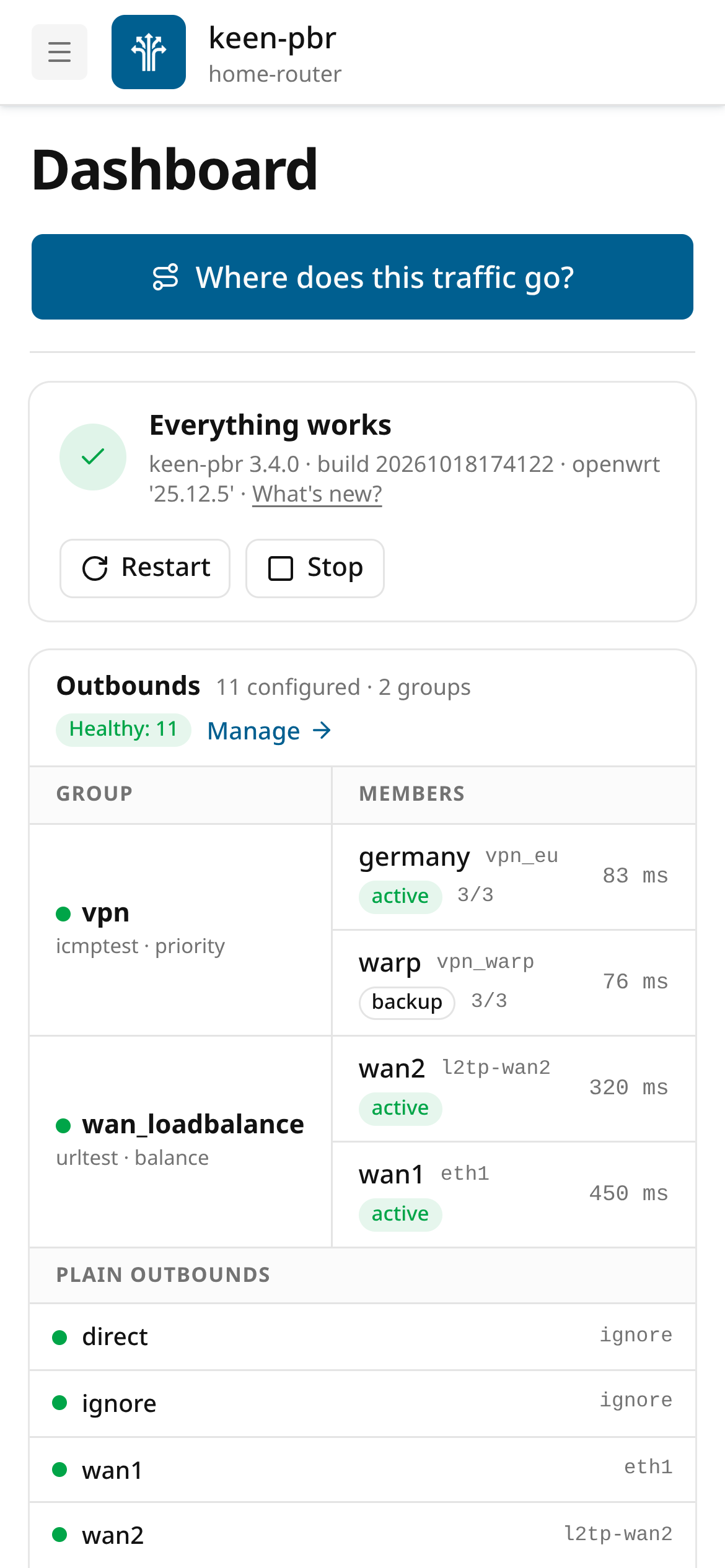
The Overview page is more compact: the service state on top, then the outbounds table, the list of problems, DNS interception, DNS rules and counters. The routing test opens in a separate window. The status line has a “What’s new?” link that opens this page.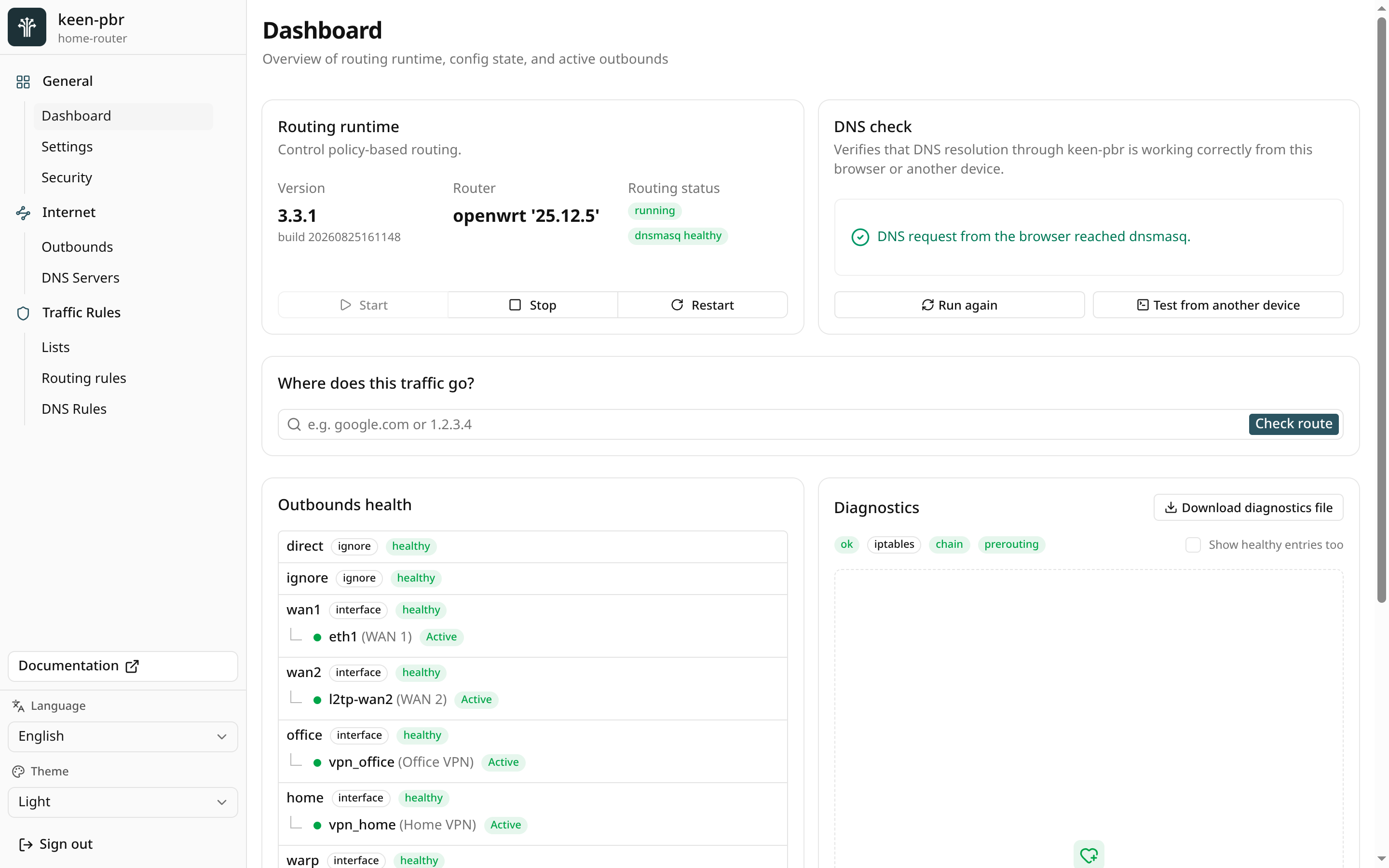
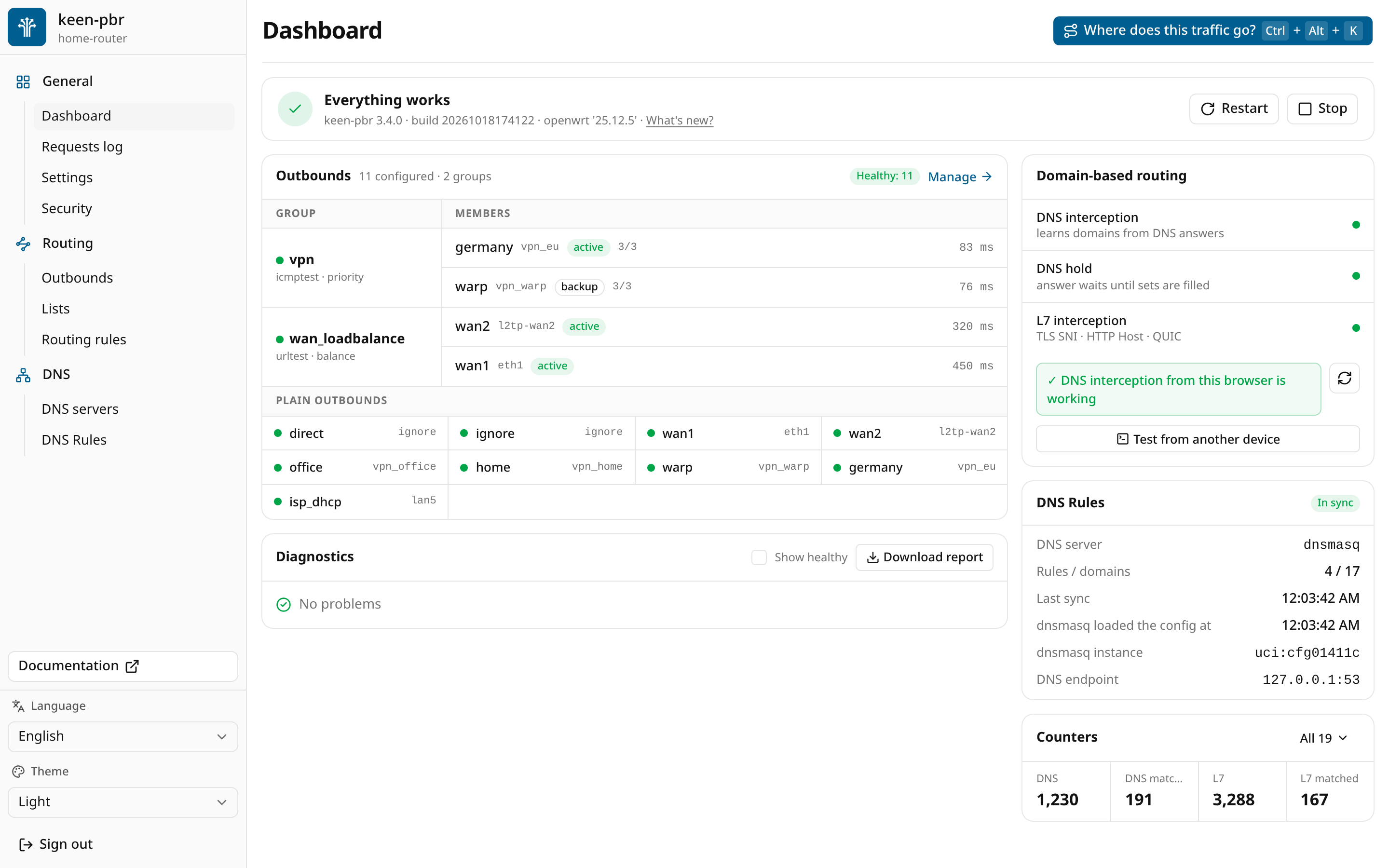 Before
After
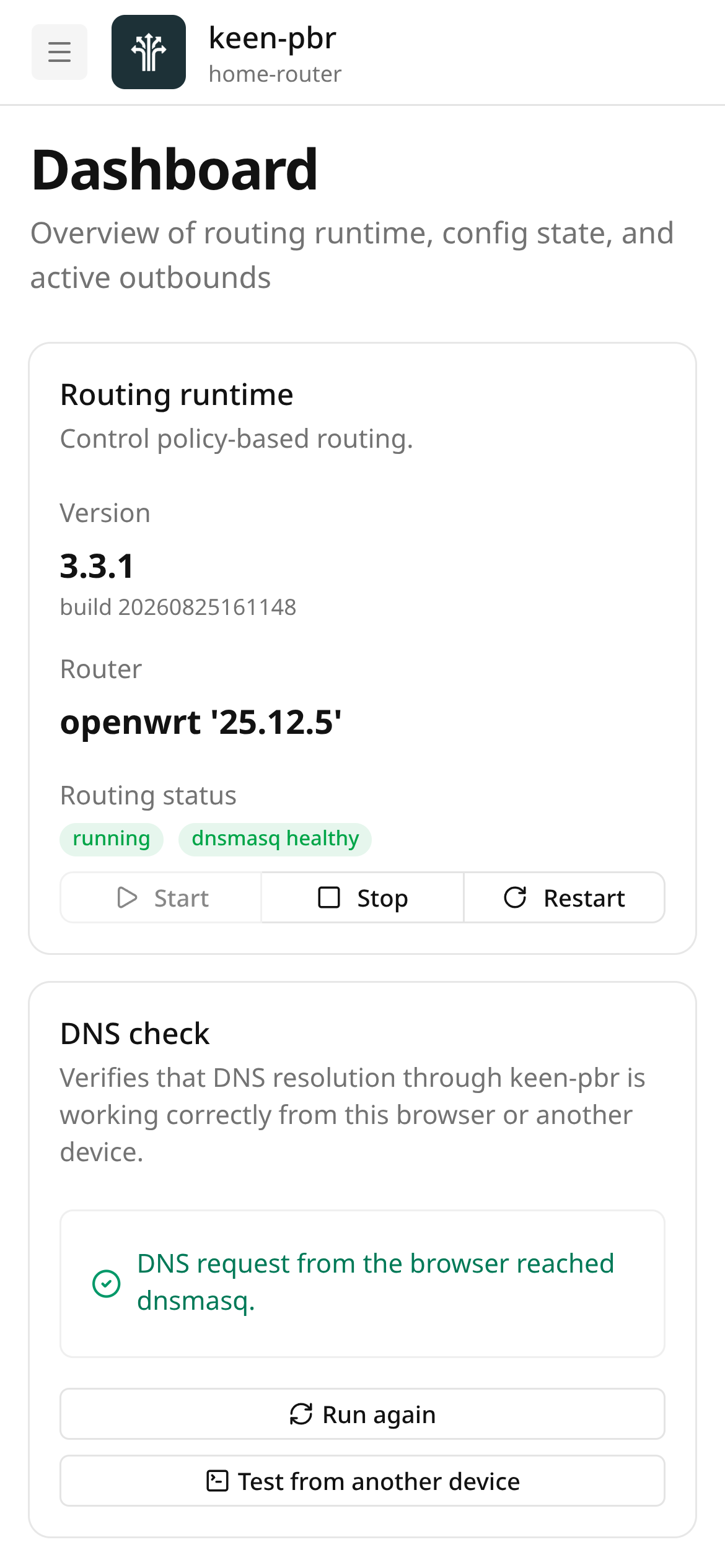
 Before
After
Dashboard -
Diagnostics.
All problems are in one list: kernel, routing, outbound and DNS server checks. The header shows at once whether everything is fine and how many problems there are. keen-pbr builds the list itself, so it matcheskeen-pbr status.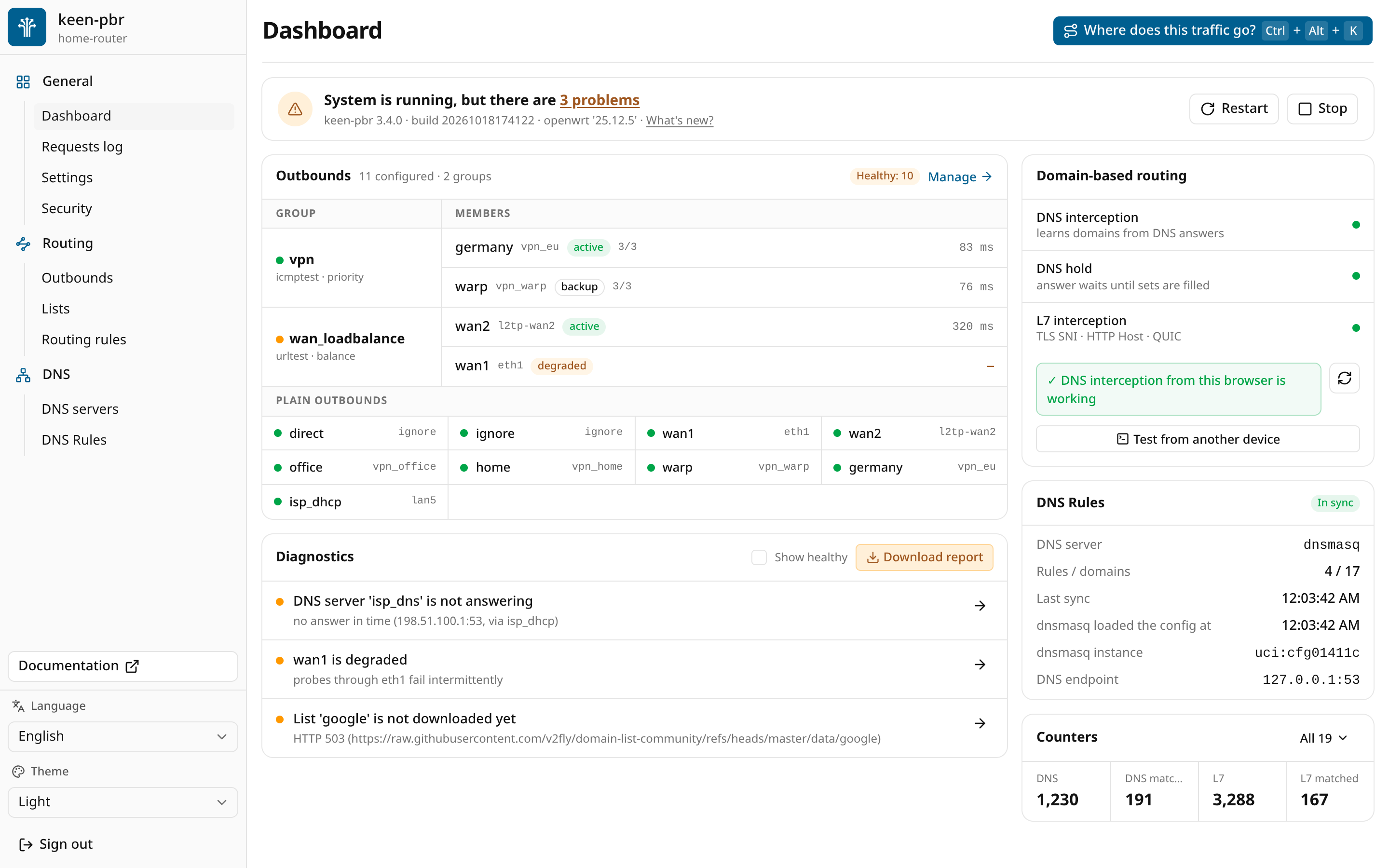
Diagnostics -
Health checks.
keen-pbr warns about missing NAT or strictrp_filteron balanced links, foreign fwmarks that overlapfwmark.mask, and missing iptables extensions.keen-pbr statusshows the same issue list as the Web UI. -
Warning about a DNS server that does not answer.
If 10 requests in a row to a server got no answer or ended with an error, the status page shows a warning. See Troubleshooting. -
Redesigned route check.
The route check in the Web UI is easier to read: step by step it shows the decision made at each stage of routing: DNS resolution, list matching, rule selection and the firewall check. You can now set packet parameters in the check: protocol, ports, addresses and DSCP. The same parameters can be set in the CLI for thekeen-pbr test-routingcommand.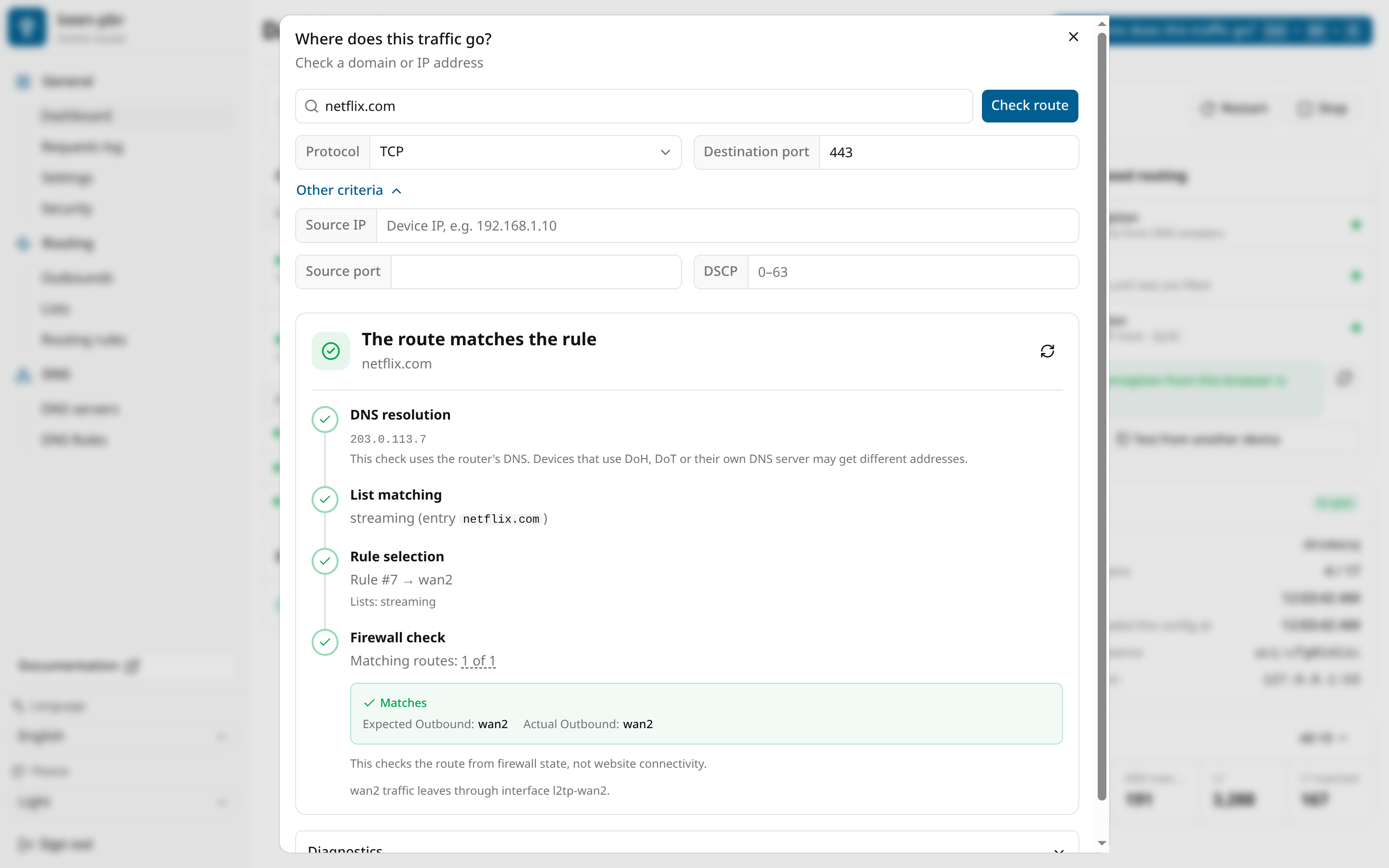
Route check -
Request log.
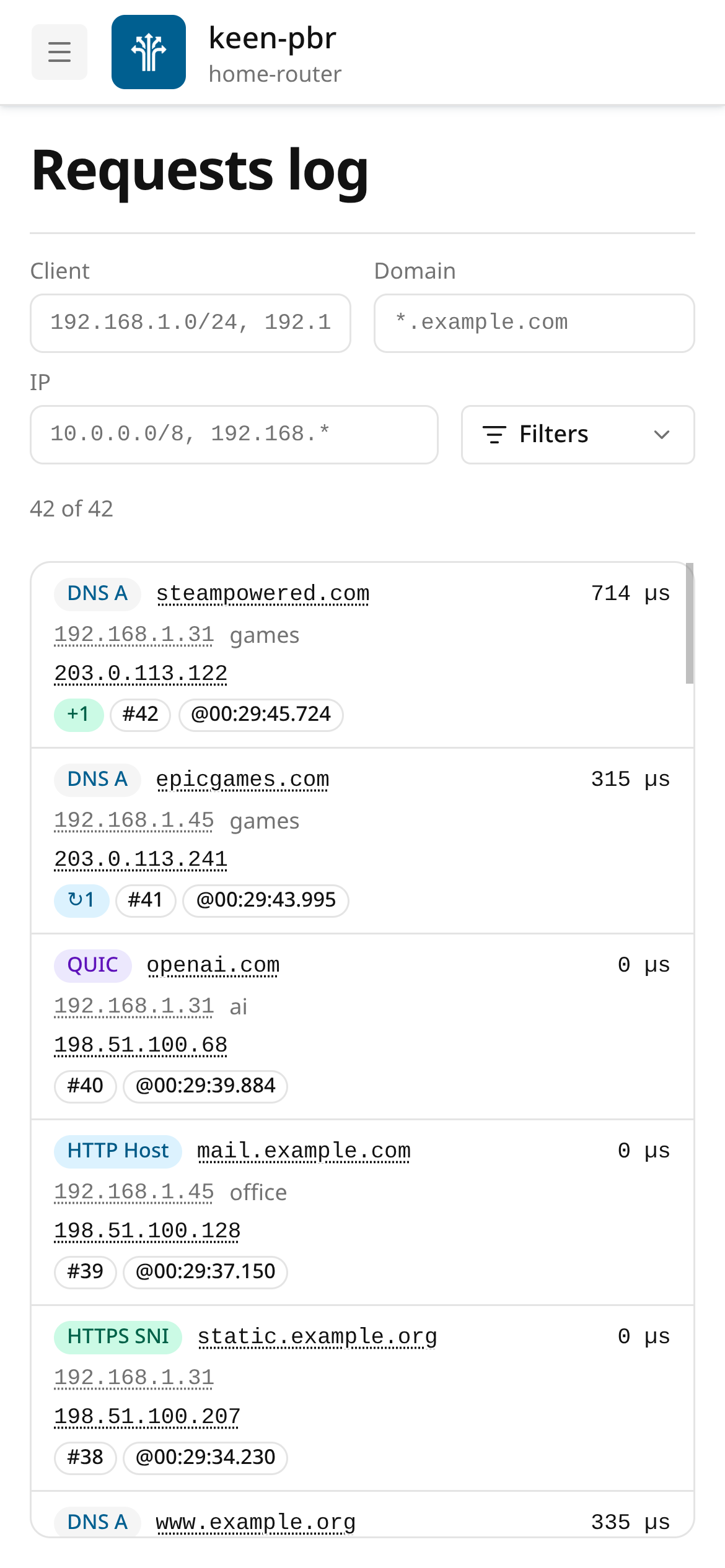
A new section: a live table of current requests and a request log with explained badges and filters.Desktop version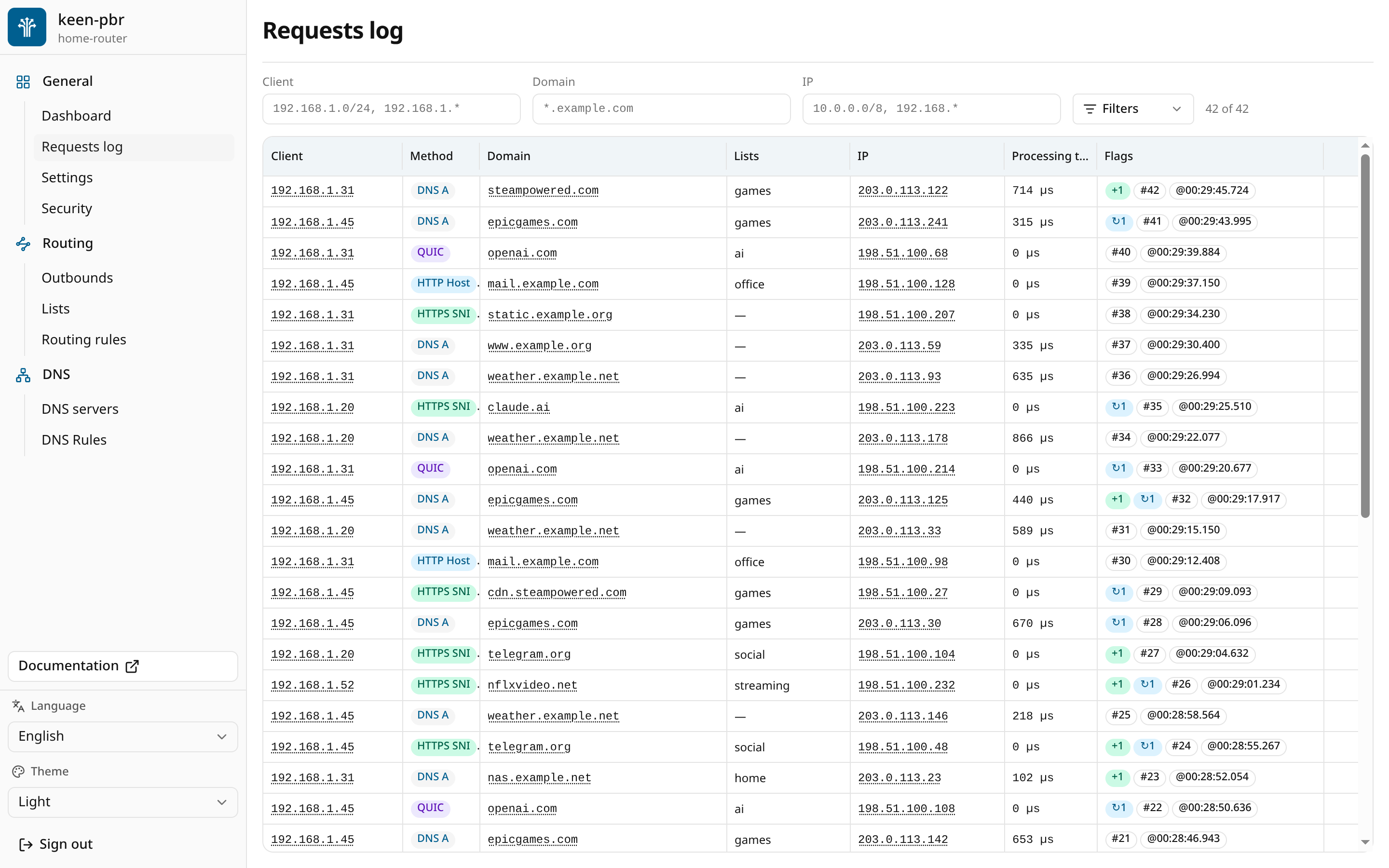 Mobile version
Requests log -
Settings page.
Empty fields show the default values. Before, saving wrote them into the config and pinned them to you; now only what you changed ends up in the config.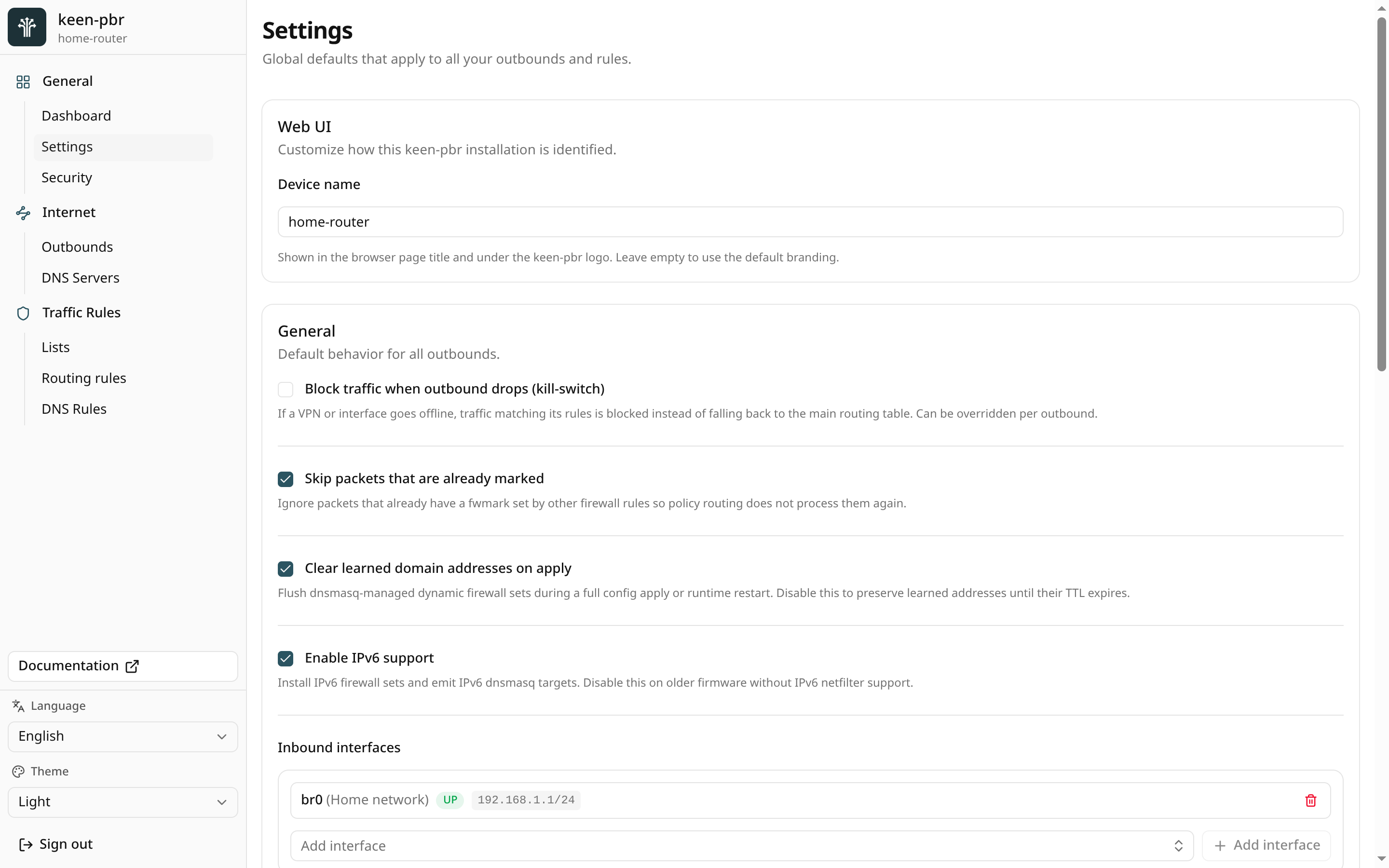
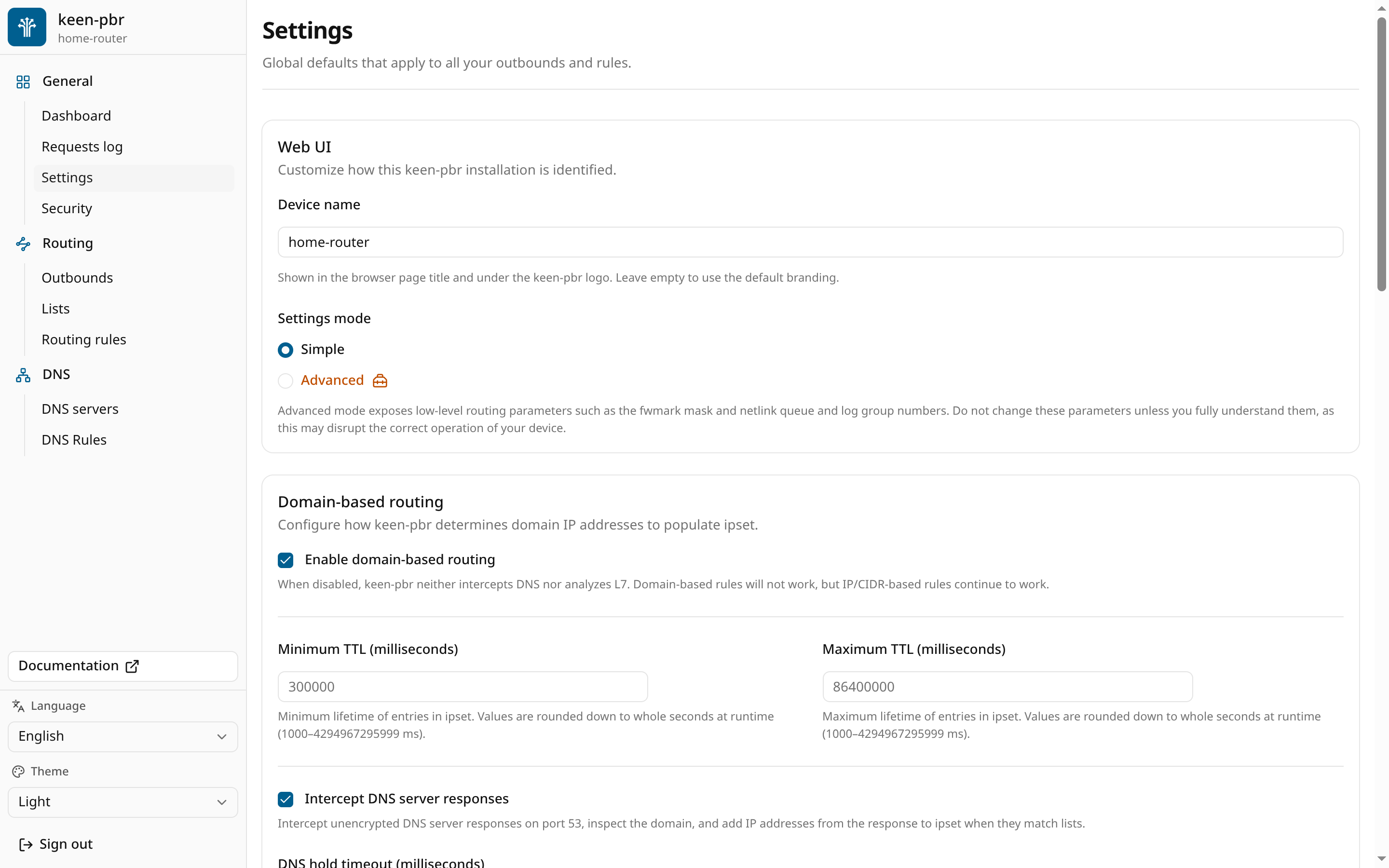 Before
After
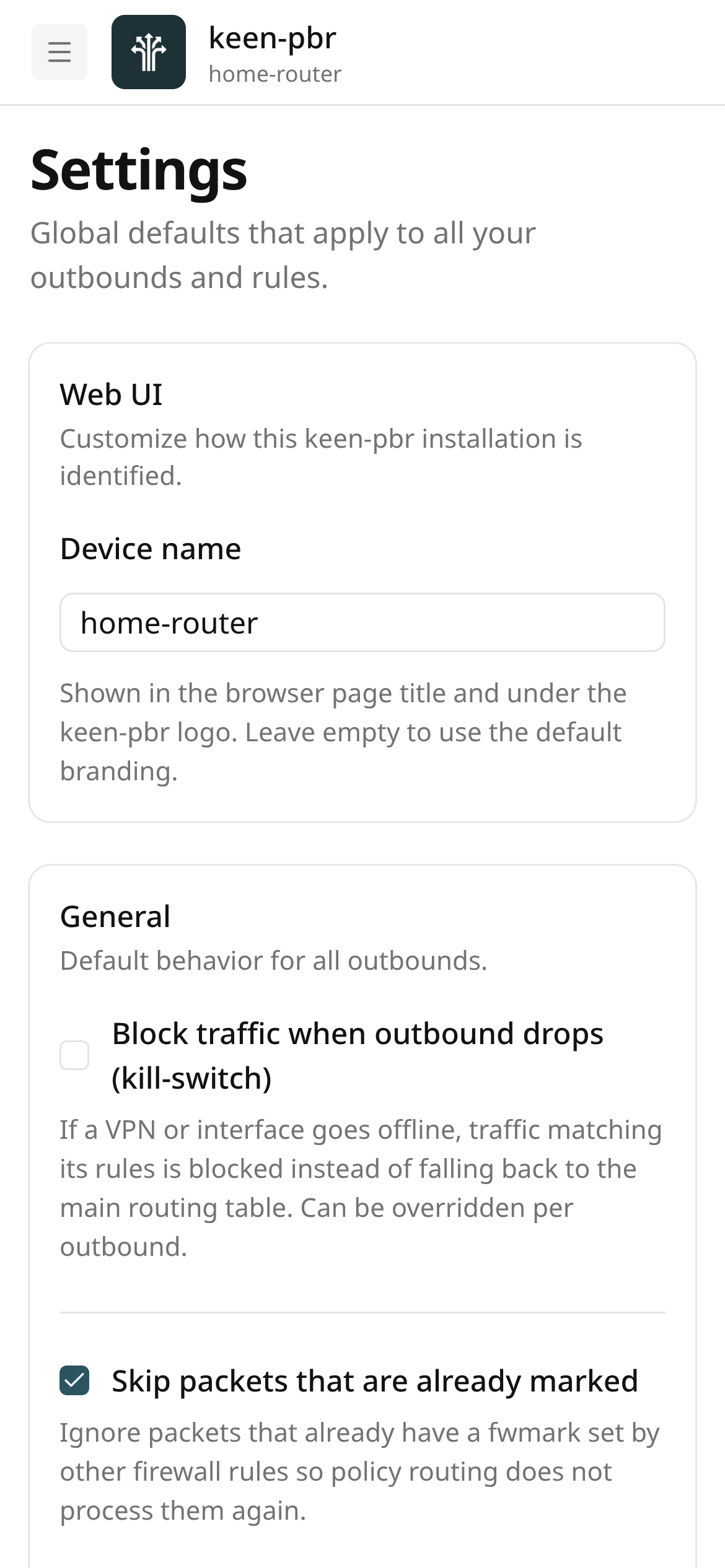
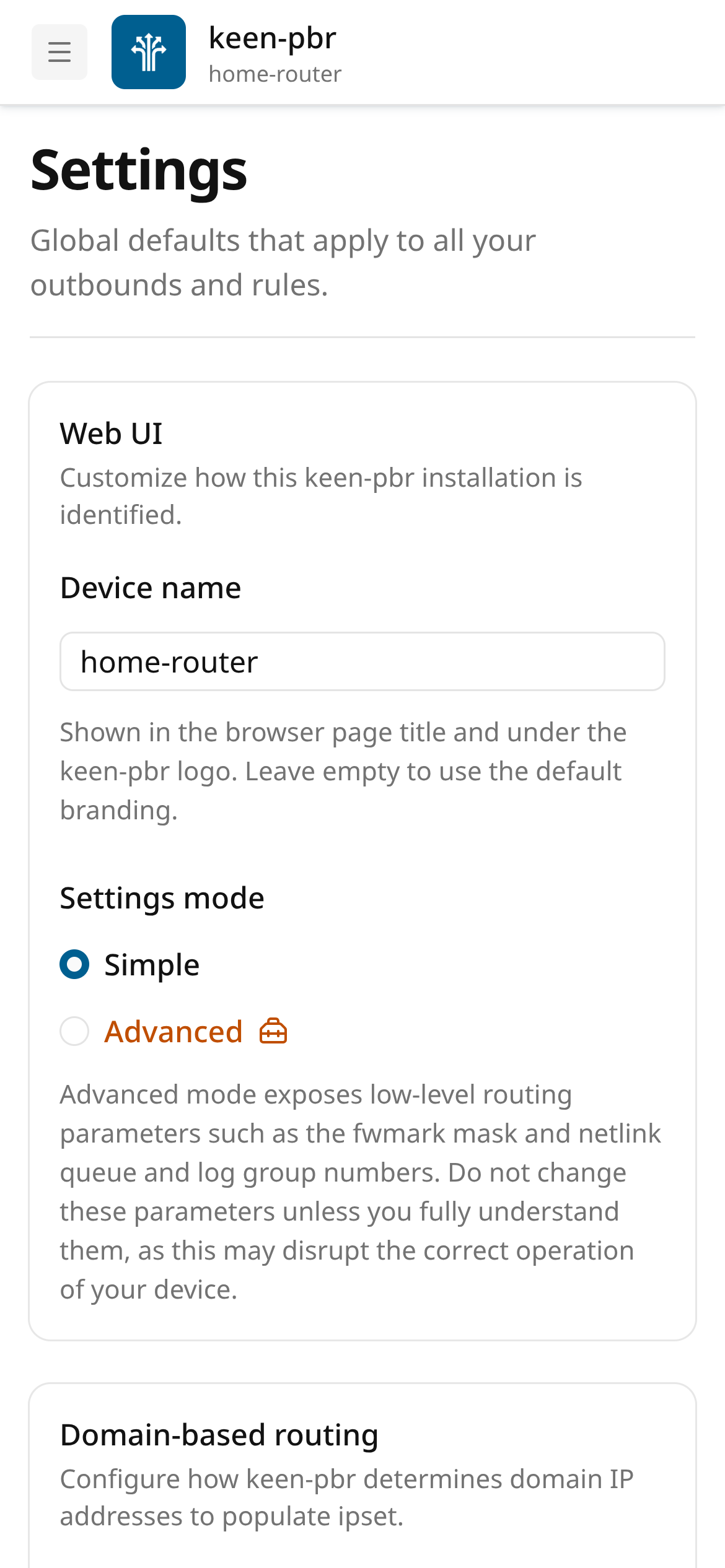 Before
After
Settings -
Domain routing no longer requires dnsmasq.
keen-pbr reads the DNS replies passing through the router and fills the sets of your lists itself. If a device looks up the site over plain DNS, the very first connection already takes the right route. See DNS.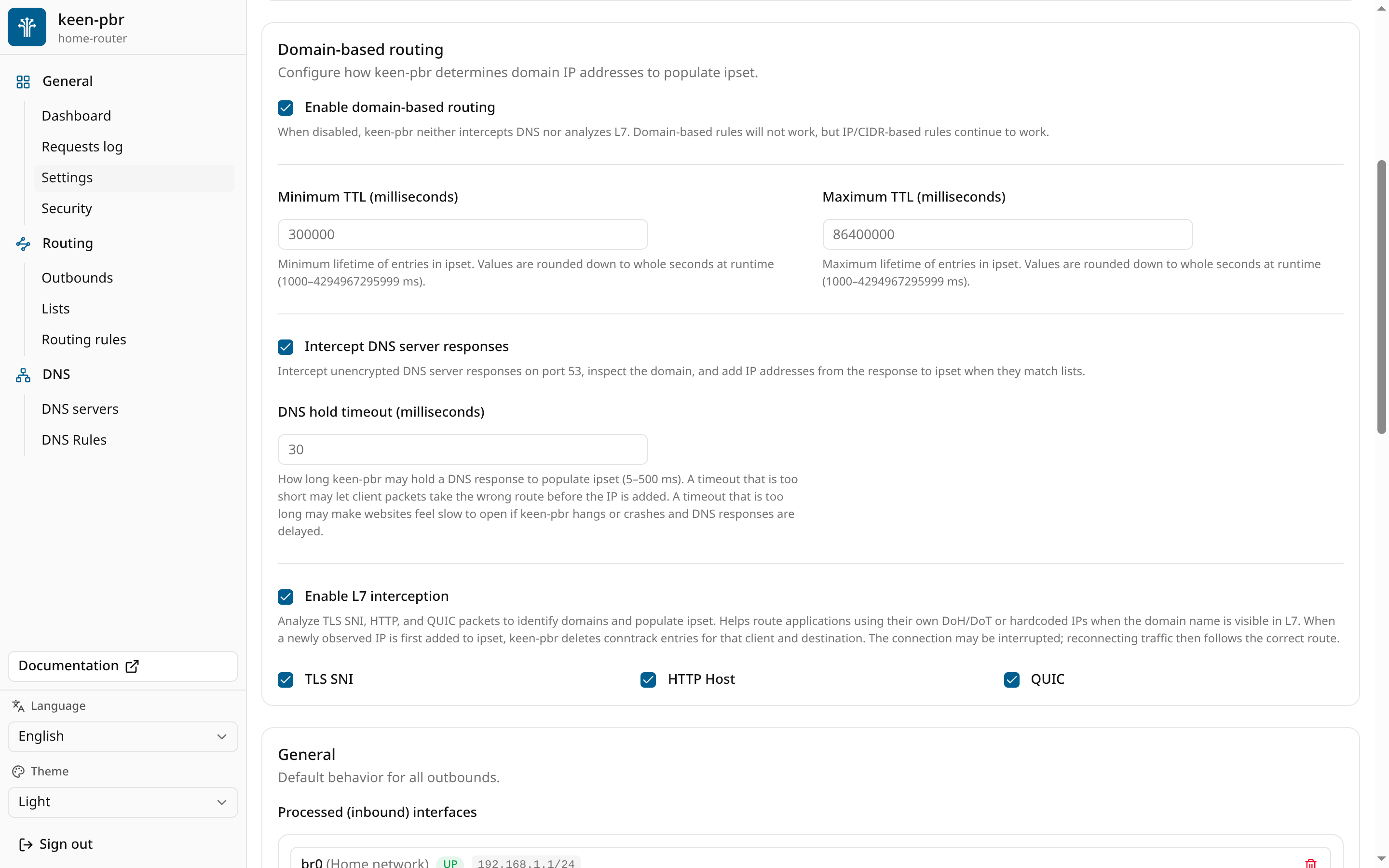
Domain-based routing settings -
L7 interception (HTTP Host, SNI, QUIC).
If the device uses encrypted DNS, keen-pbr learns the site from its name at the start of the TLS, HTTP or QUIC connection. That first connection breaks, and the browser or app reconnects, this time over the right route. -
If the kernel lacks a feature.
Only the affected part of interception (DNS or connections) is turned off, and the status page says why.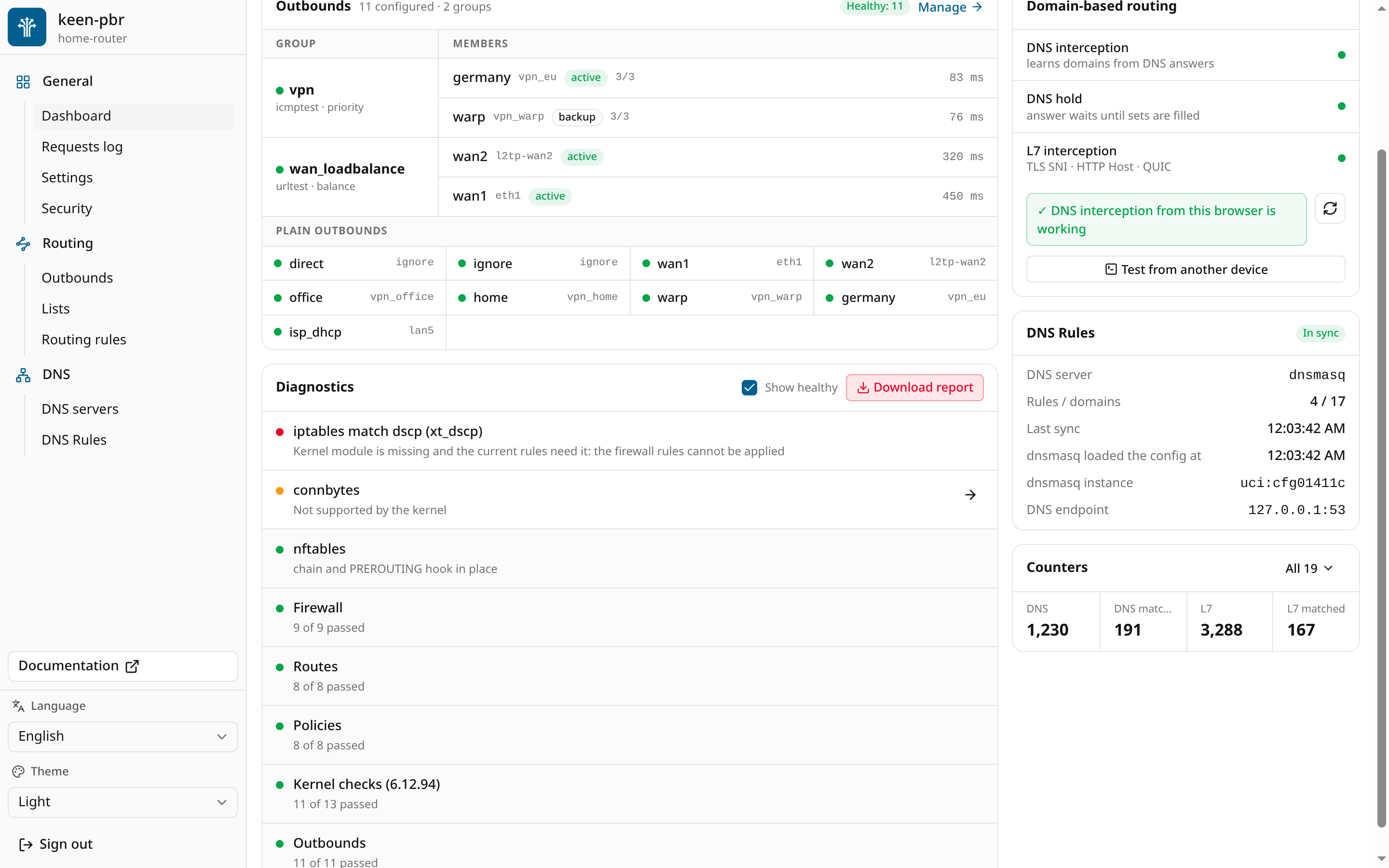
Kernel checks in diagnostics -
The router’s own traffic is not processed by default.
Route rules apply to devices in your network. To include the router, setiproute.process_router_traffictotrue. See iproute. -
The outbound editor was updated.
The editor is easier to read and less cluttered. You choose the outbound type with large cards that briefly explain how each one works. Groups (urltestandicmptest) are built visually: you can see the priority tiers and which one is in use now, set a weight for each link and see its share of traffic right away. The selection logic is also spelled out in text, for example: “New connections are spread across the working outbounds of tier 1 according to their weights”. The kill-switch behavior is chosen with cards too, each saying what happens to the traffic, and rarely needed settings are tucked into collapsible sections.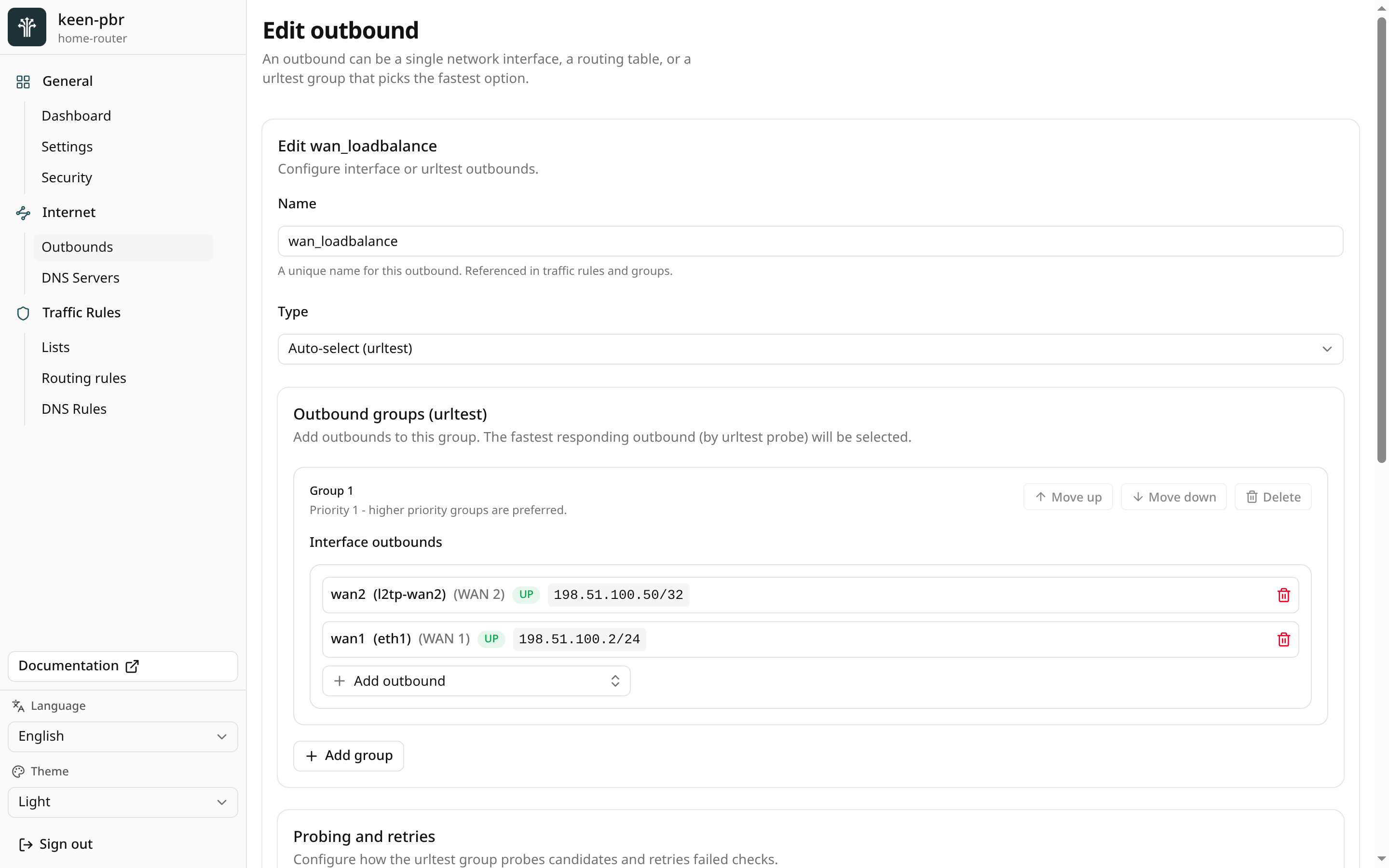
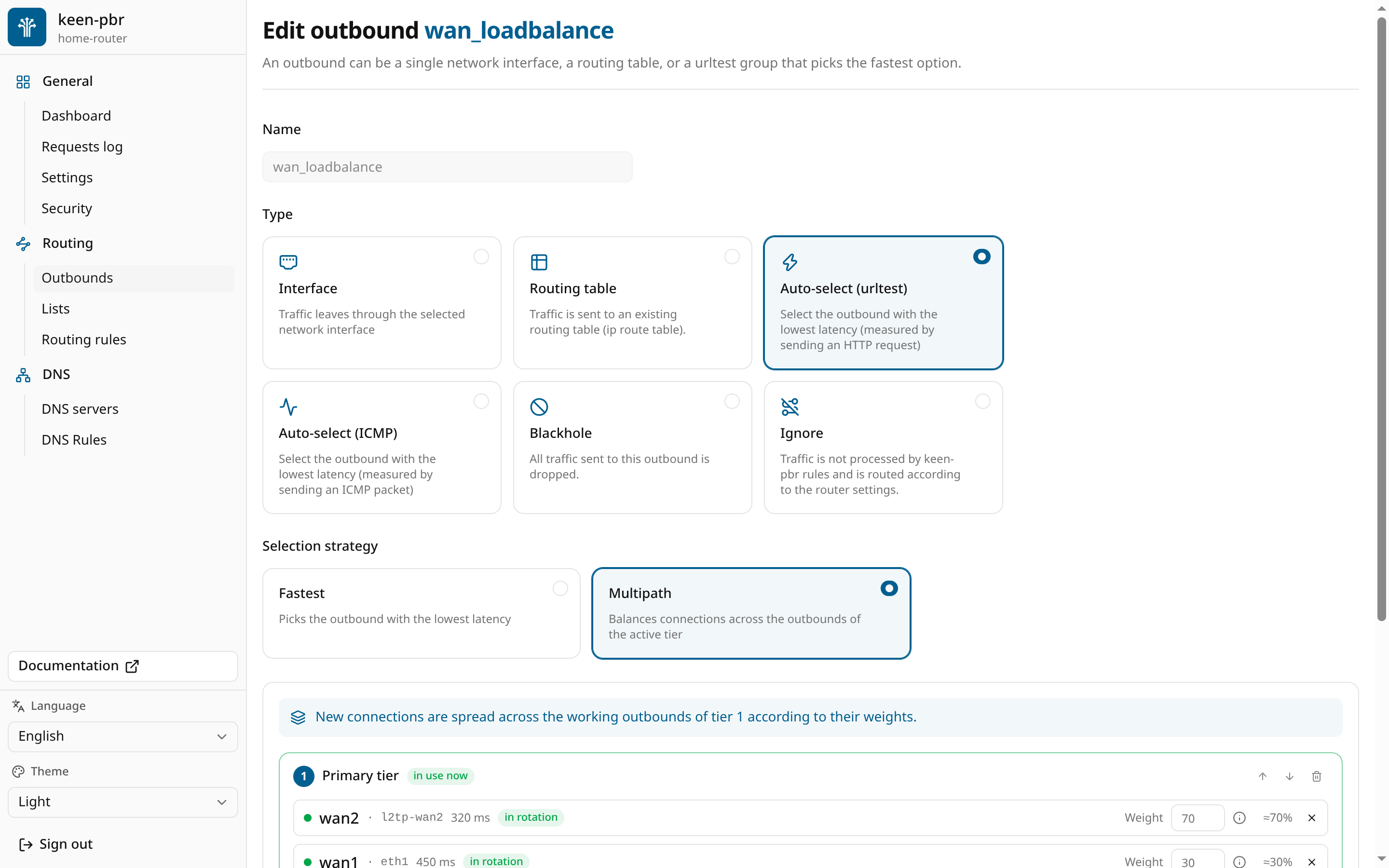 Before
After
Outbound editor -
Load balancing across several links. OpenWrtDebian
Aurltestoricmptestoutbound withstrategy: "balance"spreads connections across links, each with its own weight. A connection stays on the link it started on. See Multi-WAN Load Balancing. -
Automatic gateway detection.
Aninterfaceoutbound can use"gateway": "auto", and the default gateway can now be edited in the Web UI. See interface.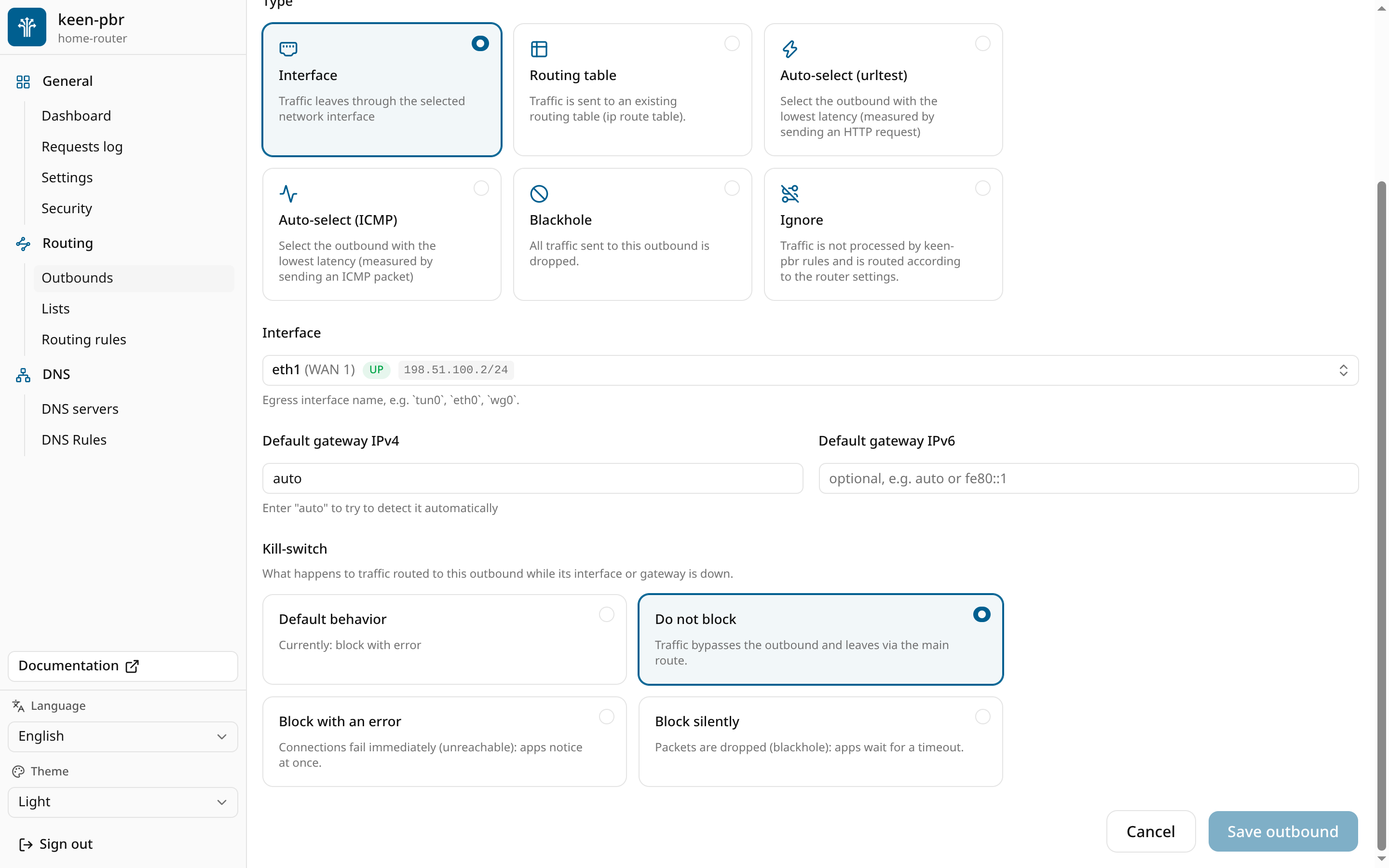
Gateway auto in the outbound editor -
New lists are downloaded in the background after a configuration is applied, not before. A failed download no longer cancels the apply and shows up in the warnings instead. Lists that failed to download at start are downloaded again the same way.
-
The routing rule page was updated.
Instead of one long form with all the fields at once, a rule is now built like a “IF … AND … then …” constructor. You add the conditions one at a time (lists, protocol, ports, addresses, DSCP), each one has a short note on what exactly it checks, and at the bottom you choose the outbound for the matching traffic. You see at once what the rule does and do not have to scroll past fields you do not need.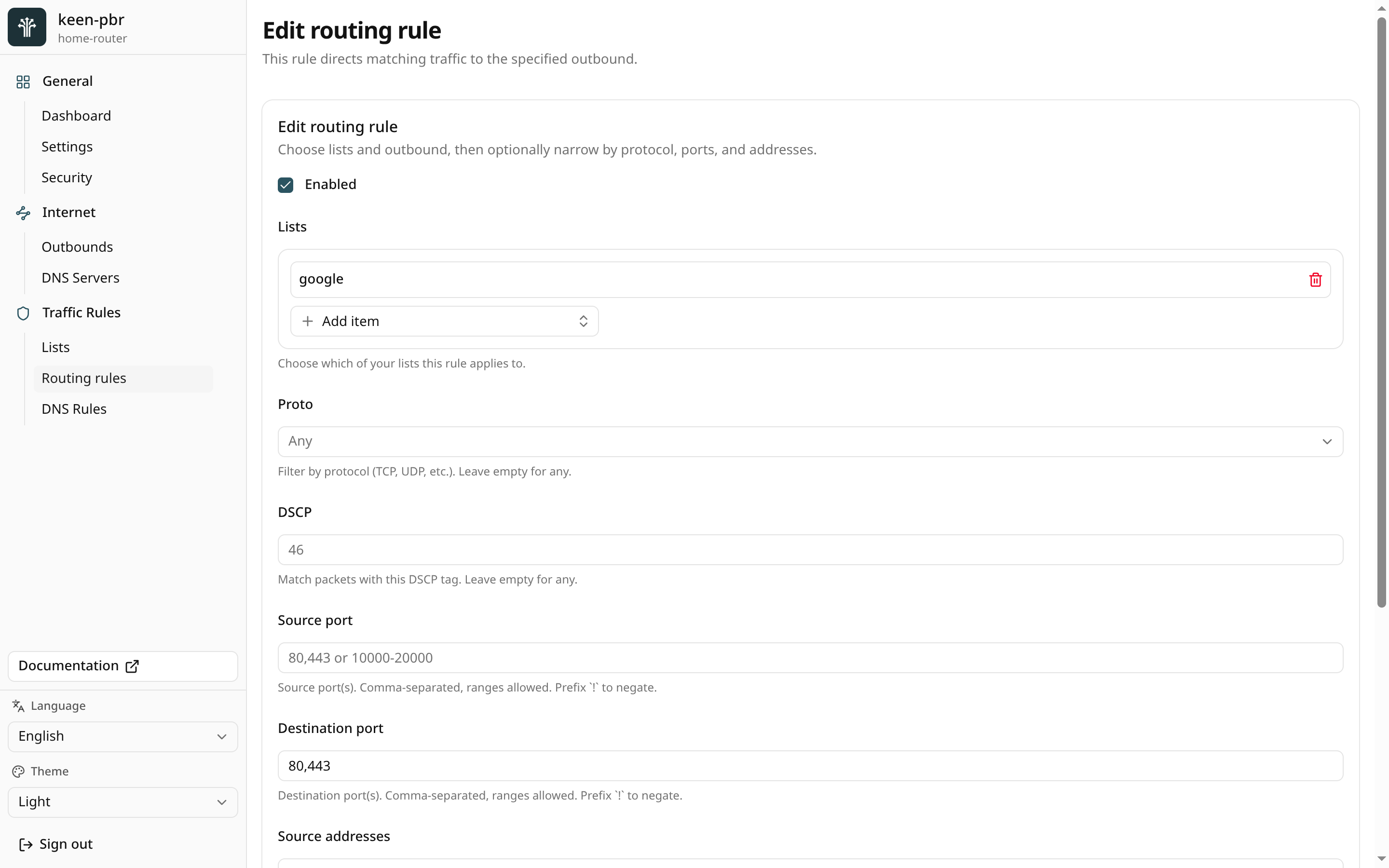
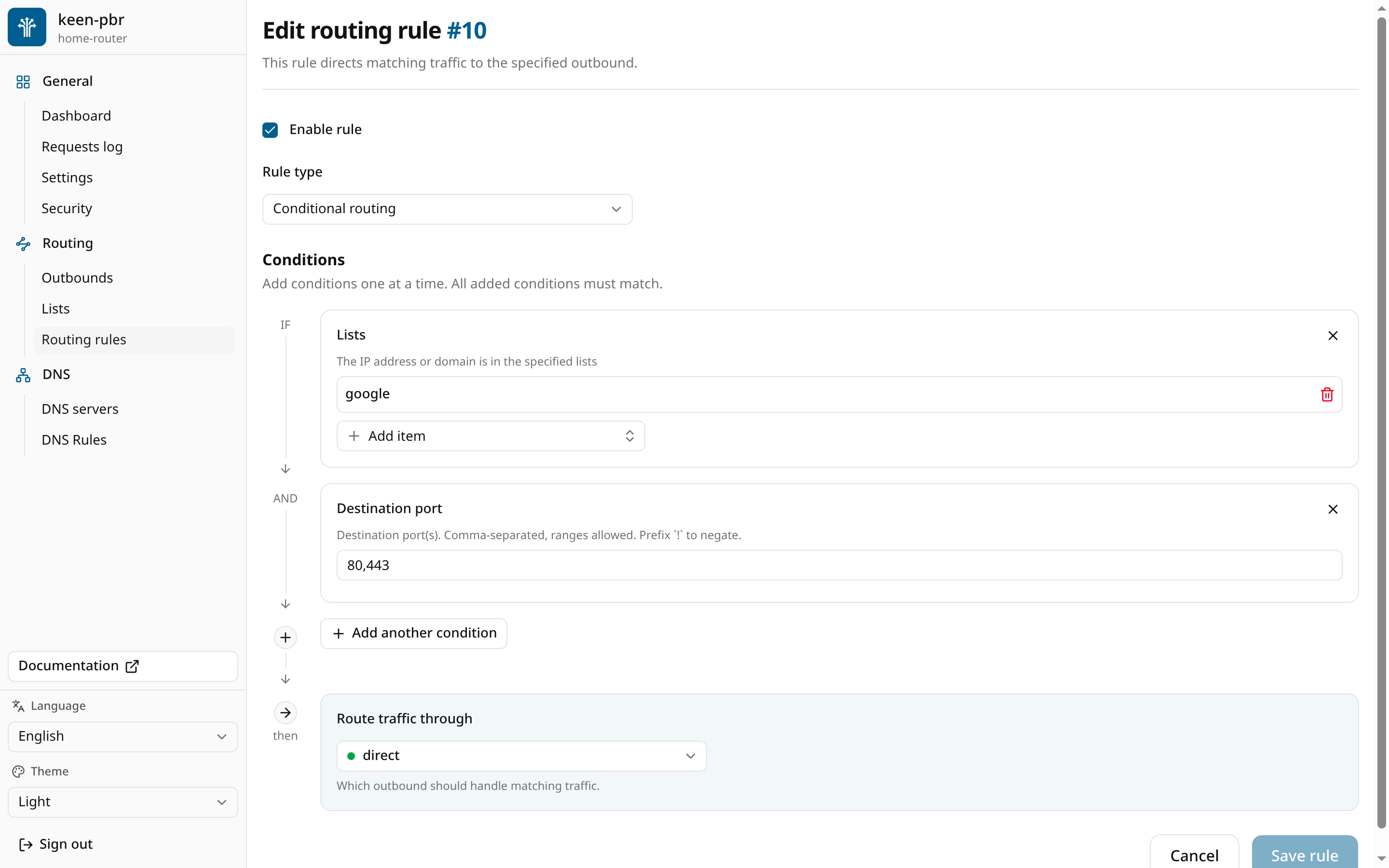 Before
After
Routing rule page -
Default route setup (for multipath or failover). OpenWrtDebian
keen-pbr can now manage the default route for the devices in your network. You can use it for multipath routing and link failover, similar to what mwan3 does. Add a rule with the IPv4 default gateway type (default_gateway; a separate rule for IPv6) at the end of the route rules and point it at aurltestoricmptestoutbound. Withstrategy: "priority"all internet traffic moves to a backup link when the main one is down, and withstrategy: "balance"connections are spread across the links by weight. Addresses of your local network still use normal routing. The rule applies to the devices in your network; to apply it to the router’s own traffic too, turn on Process router’s own traffic. Available on OpenWrt and Debian. See Route rules and Multi-WAN Load Balancing.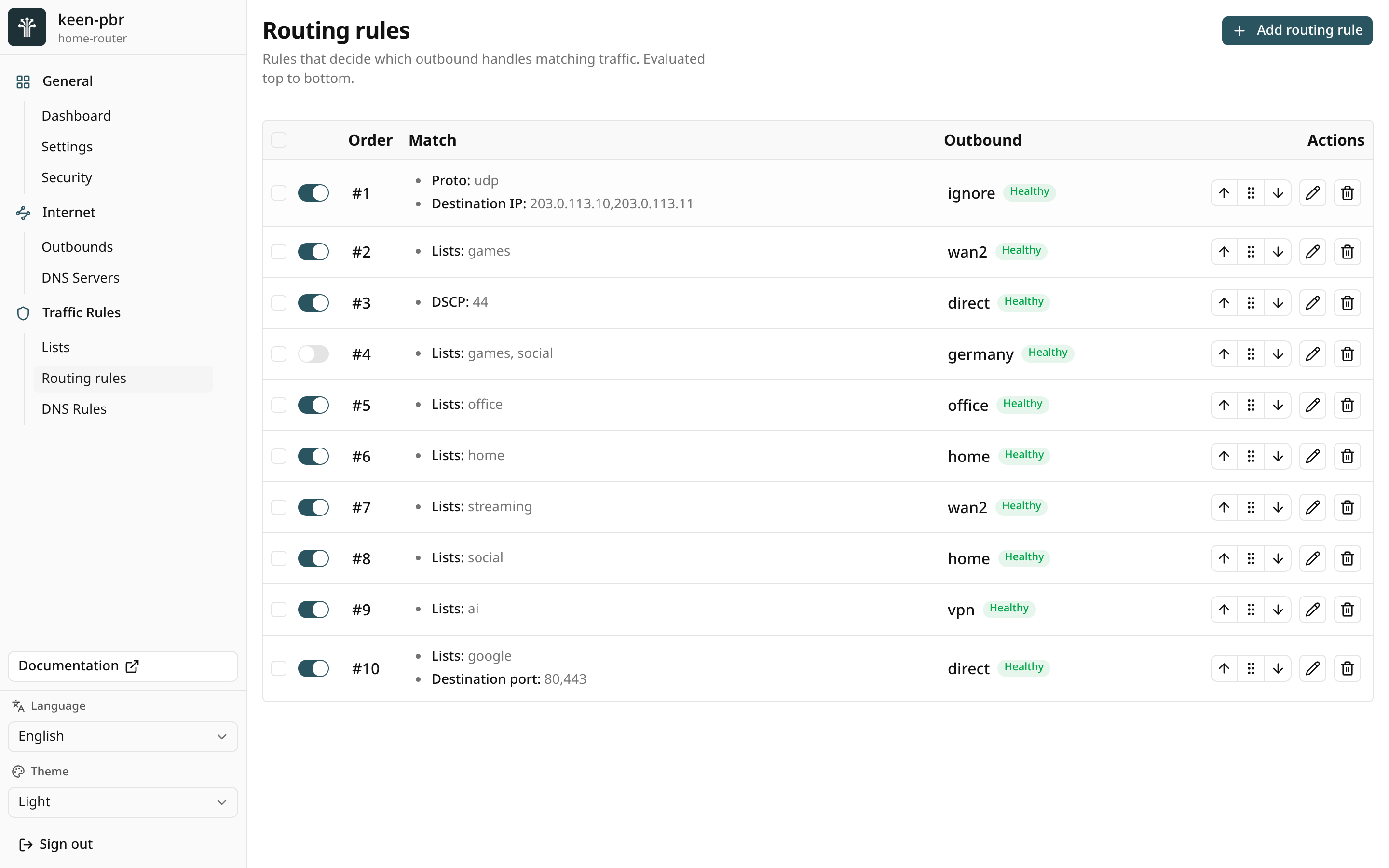
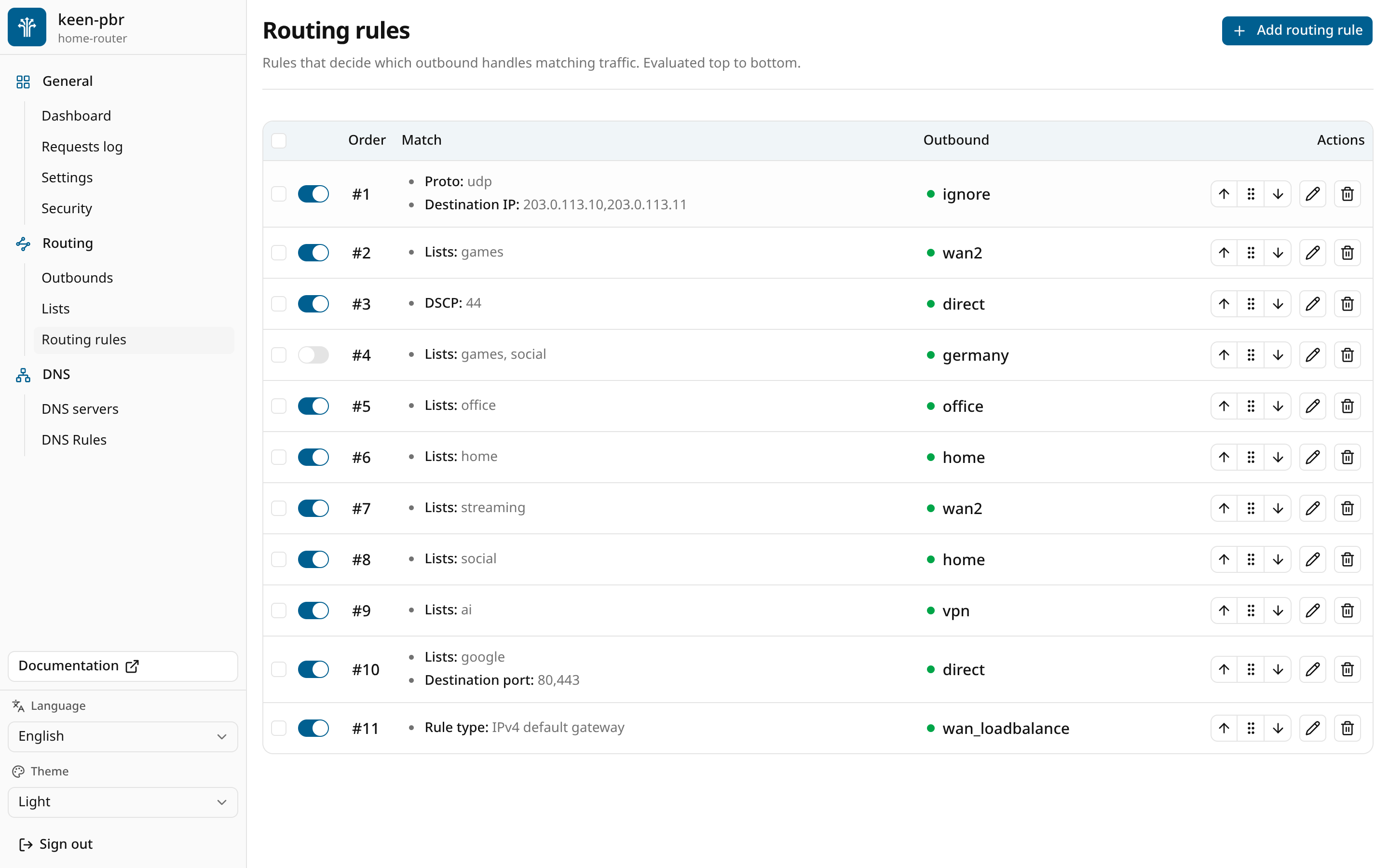 Before
After
Routing rules -
DNS-over-HTTPS.
You can now add a DNS server of type DNS-over-HTTPS and use it in DNS rules and among the main DNS servers. See DNS.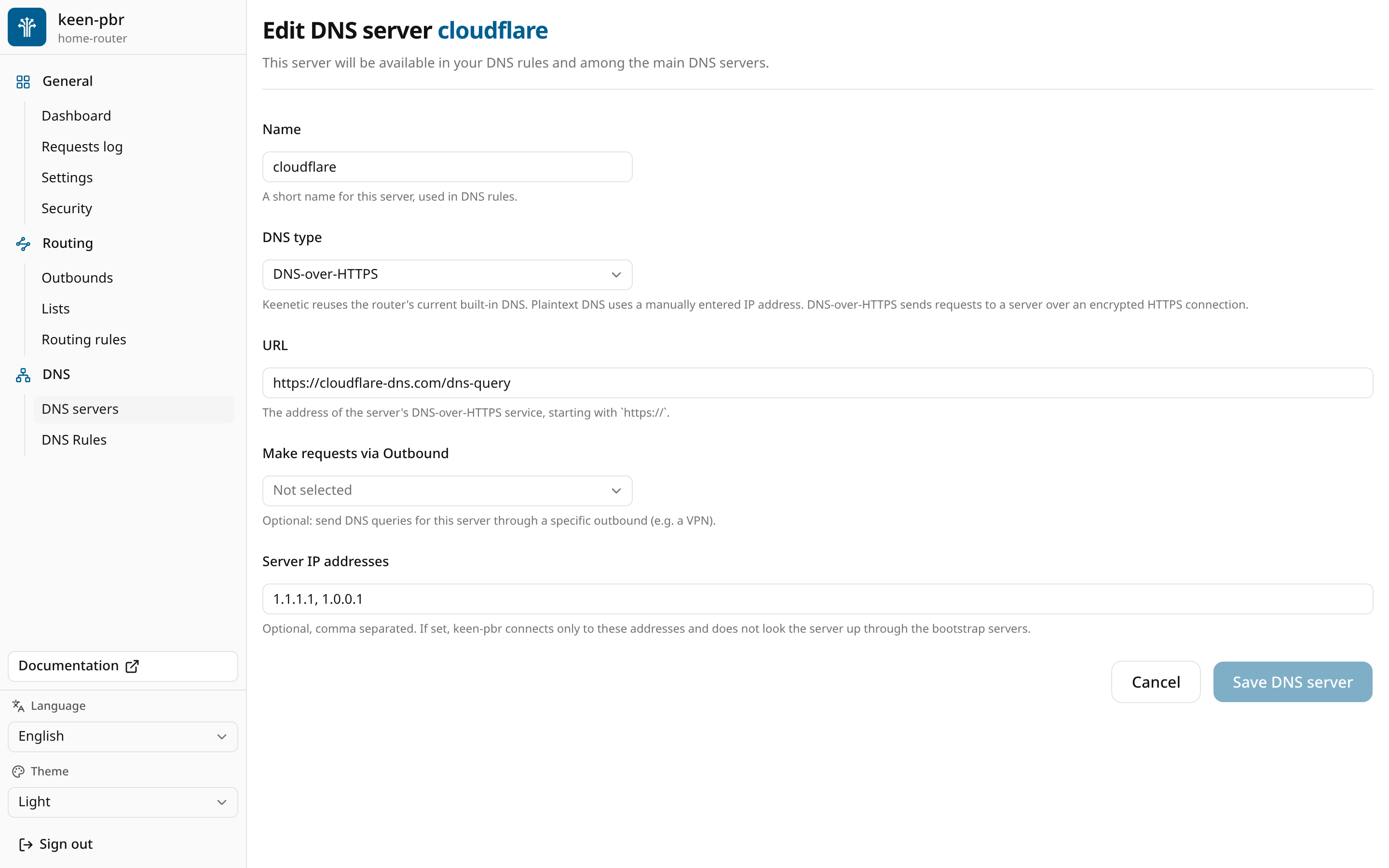
DNS-over-HTTPS server -
Bootstrap servers for DoH.
A DoH server needs an IP address to connect to. Pick bootstrap servers, and keen-pbr will look up the DoH servers’ addresses through them, or set the DoH server’s IP addresses yourself. See DNS. -
Checking the DNS servers.
The Check button on the DNS servers page asks all servers about the sites you choose and shows which do not answer and which tamper with answers: they answer that the domain does not exist (NXDOMAIN), or answer with a stub address. See DNS. Click a result to see the details for each site: the addresses received, the response time and what exactly is wrong. You can change the sites to check: tick the ready-made ones or add your own.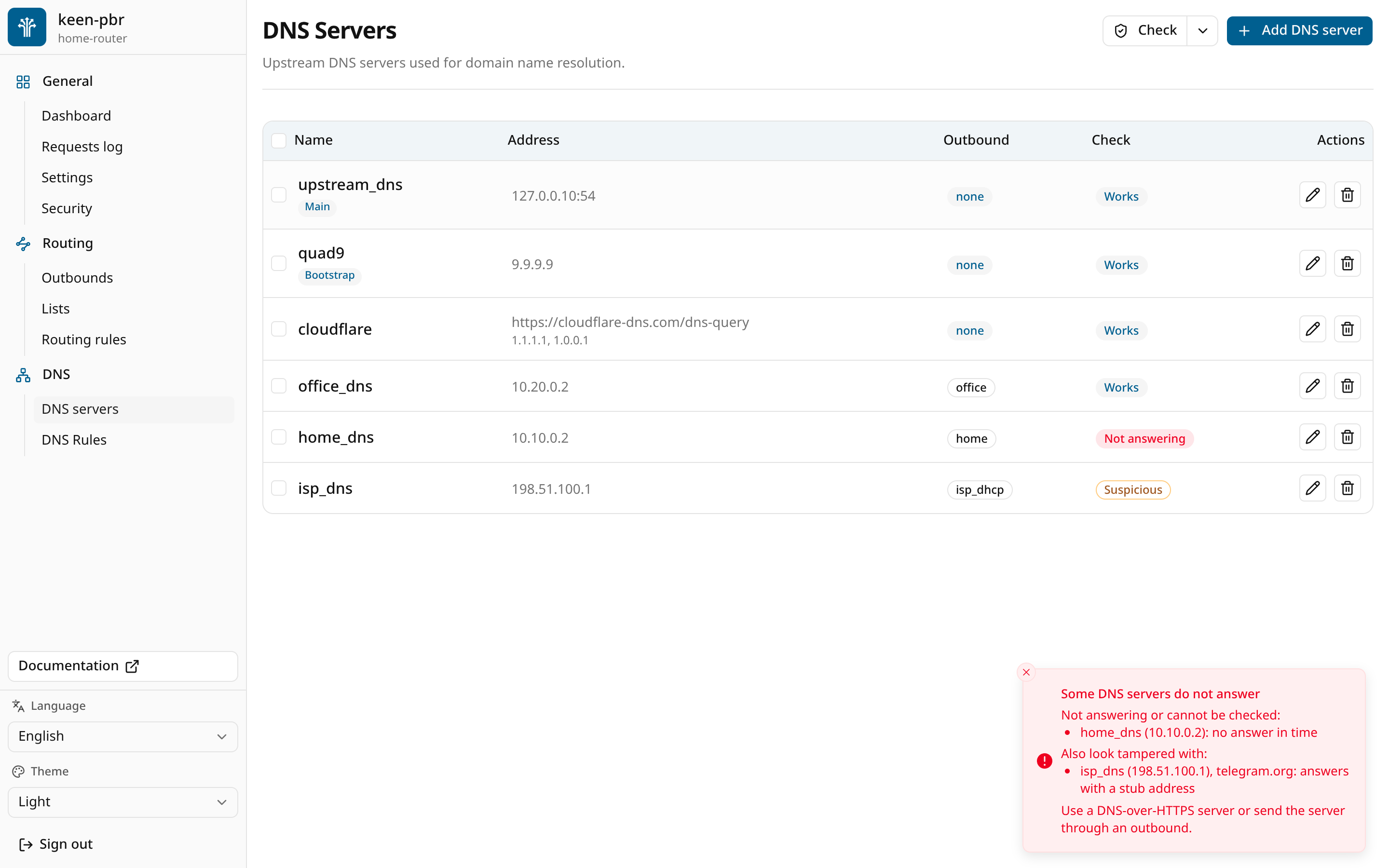
DNS servers check 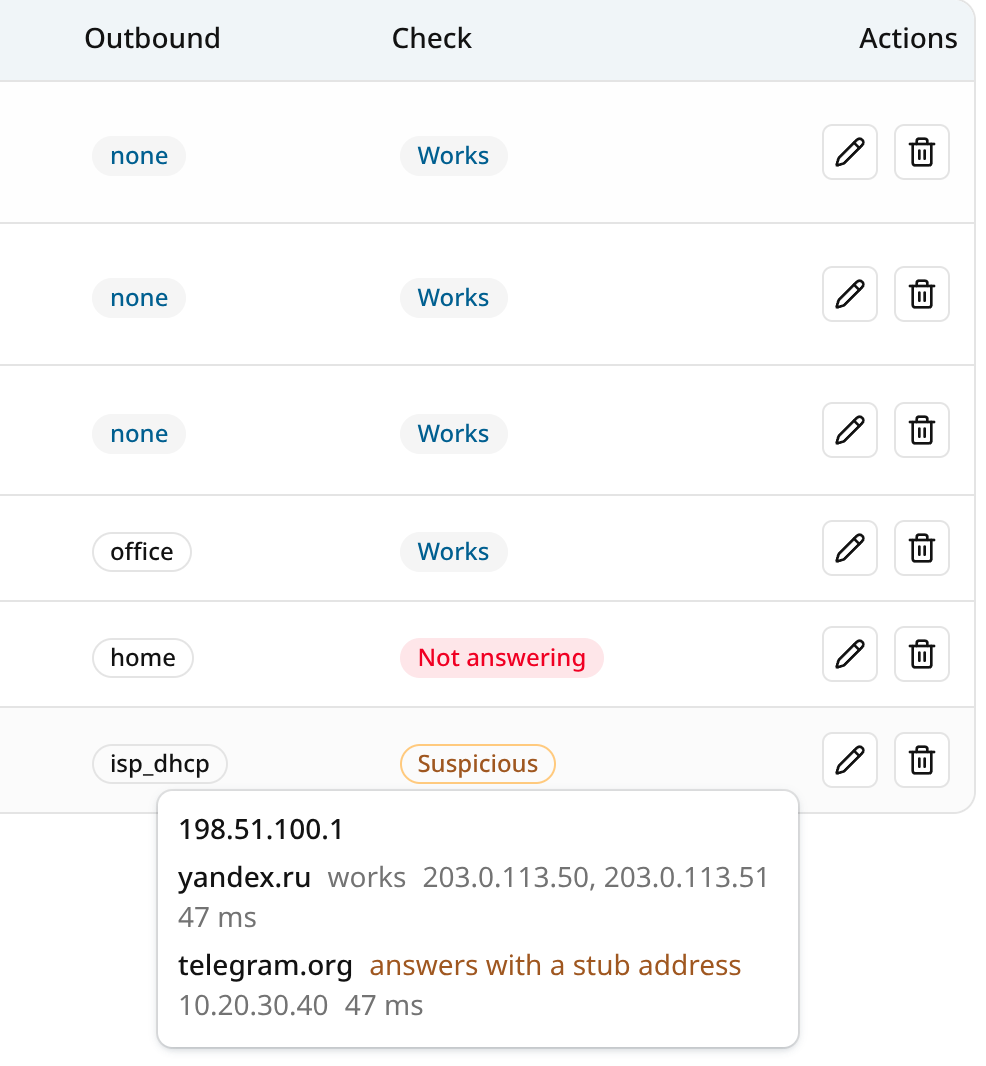
Check result details 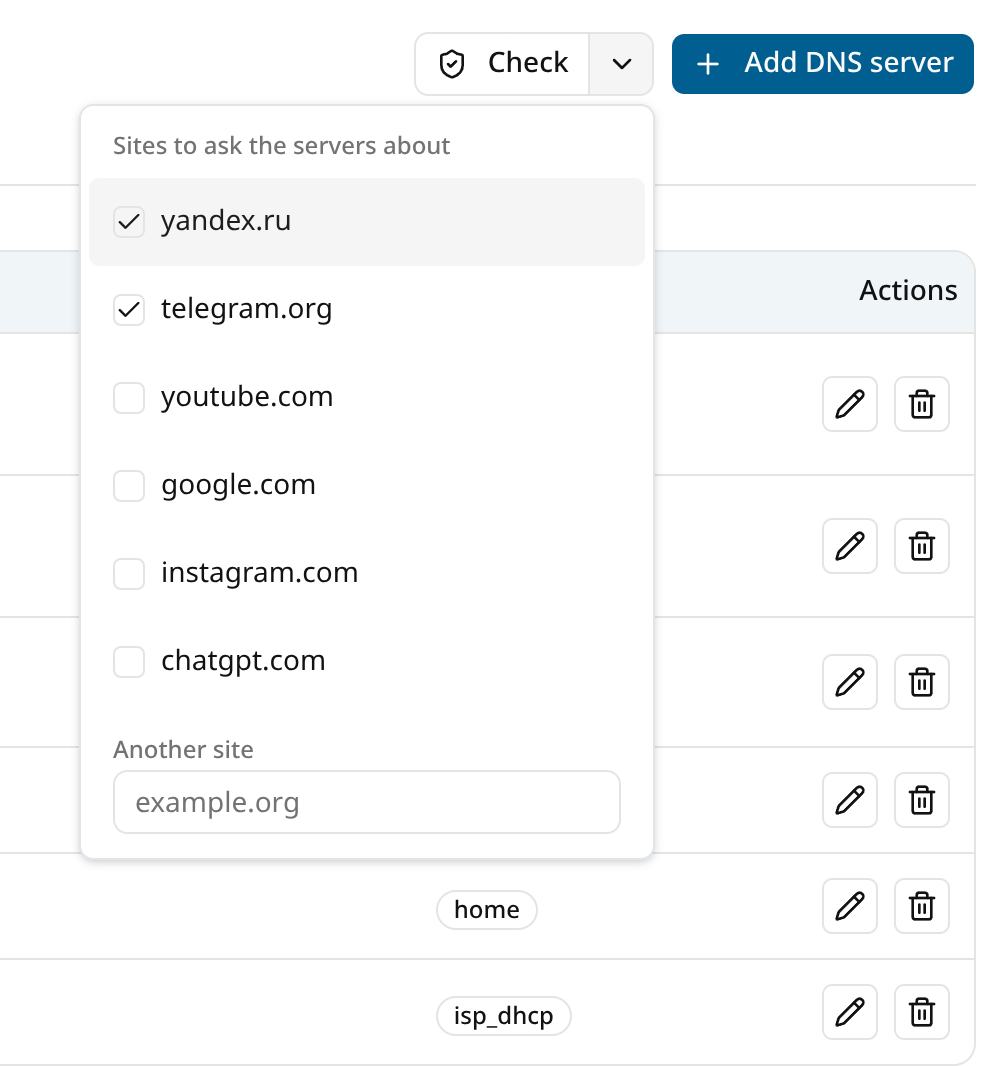
Sites for the DNS servers check -
The DNS rule page was updated.
It follows the same logic as the routing rule: first you pick the condition (the domain lists), then the DNS servers to send the queries to. With several servers the page tells you that requests go to them in turn.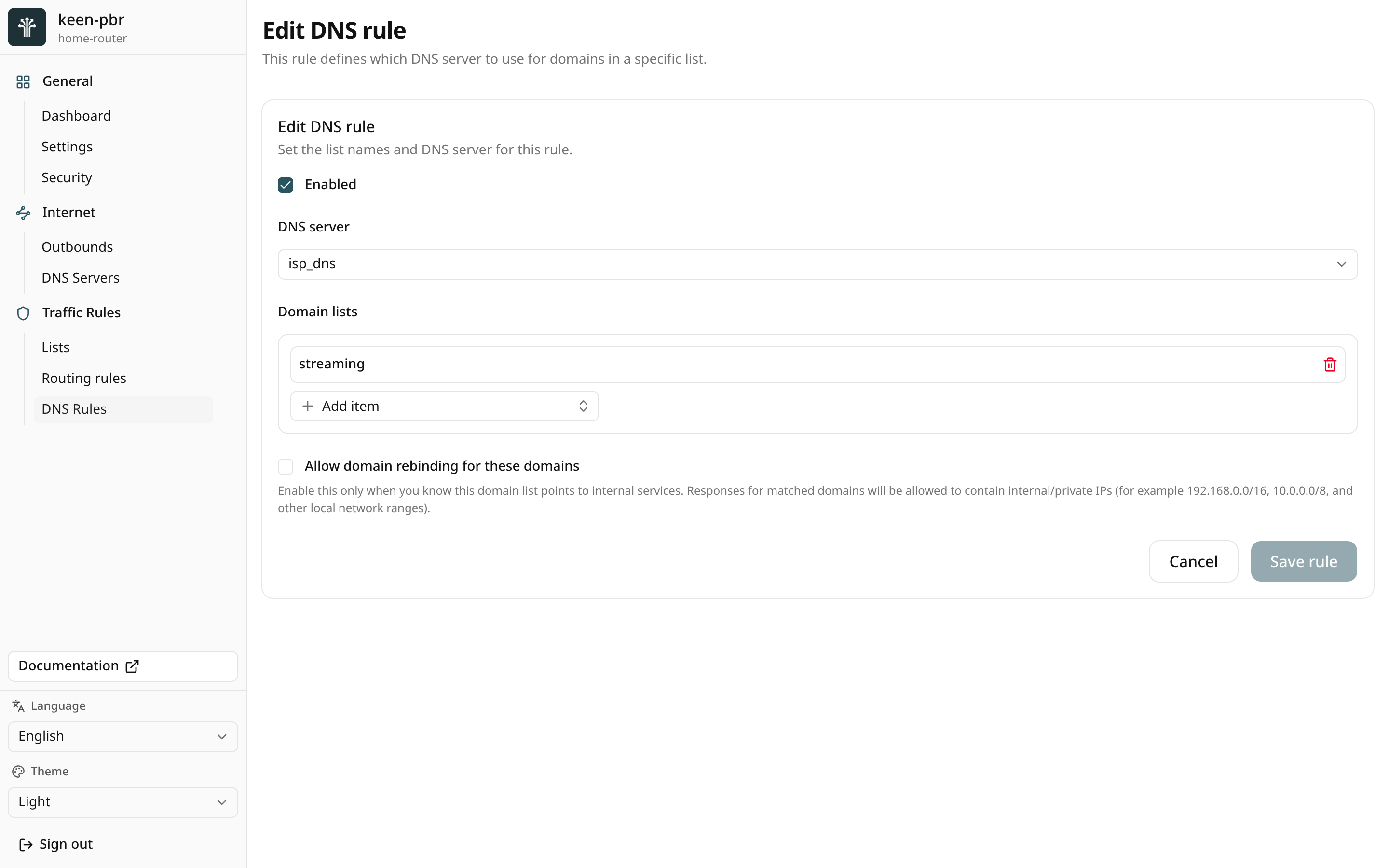
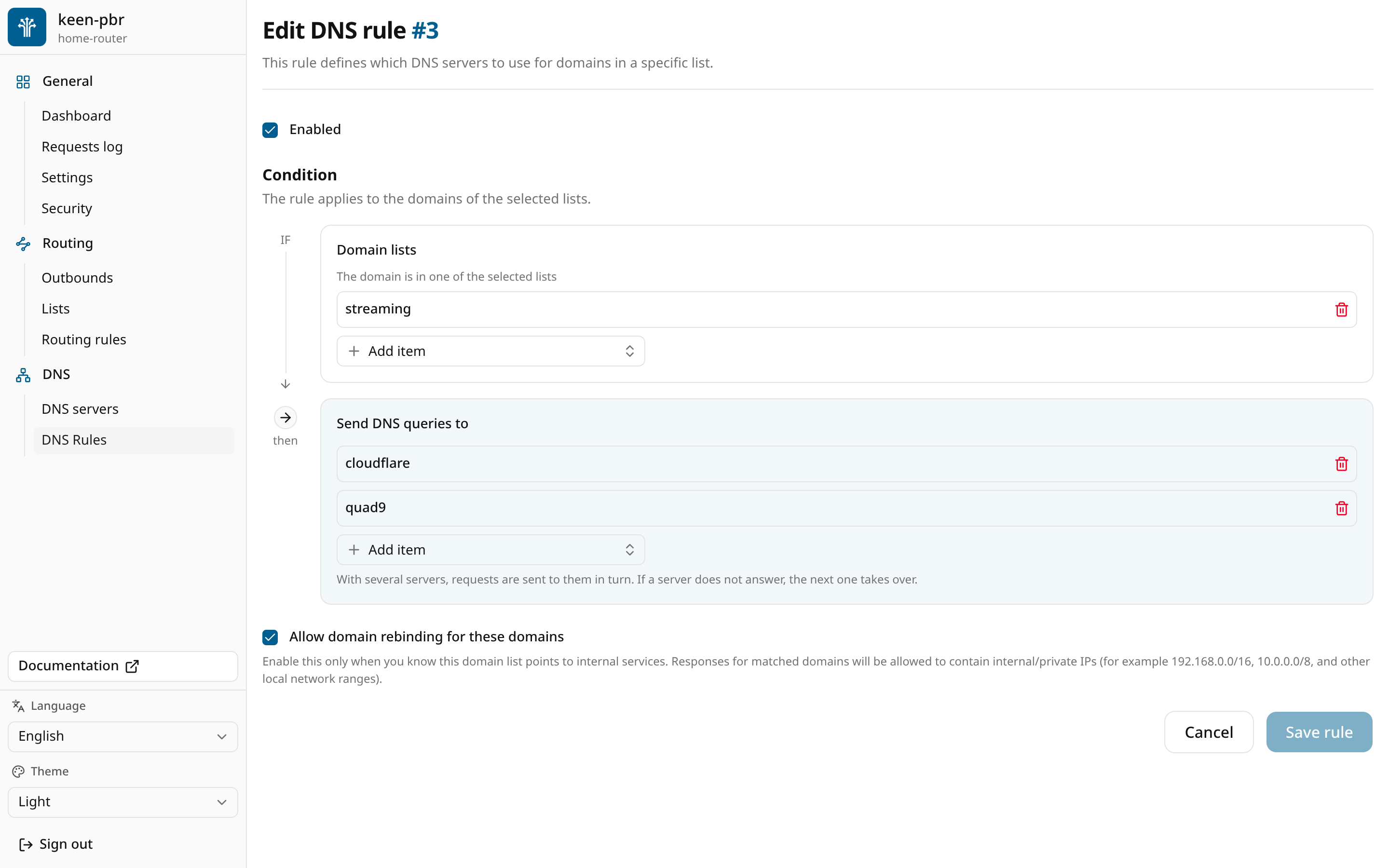 Before
After
DNS rule page -
Several DNS servers for a list.
You can pick several DNS servers for a list. Requests go to them in turn, and if a server does not answer, the next one takes over. Inconfig.jsontheserverfield of a DNS rule is nowservers, an array of server names; keen-pbr converts old configs automatically.
dnsmasq sends queries for domains of lists with several servers or with DNS-over-HTTPS to the keen-pbr built-in DNS proxy on127.0.0.89, with ports starting at 52100. You can change the address and the first port in the Advanced settings mode: DNS proxy address and First DNS proxy port. See DNS. -
On the DNS rules page the main DNS servers and the bootstrap servers are collapsible sections; a collapsed section shows which servers are in use. When no main servers are chosen or a DoH server needs bootstrap servers, the section shows a ⚠️ icon, and the Overview page and
keen-pbr statusshow a warning with a link to the page. The DNS servers table marks which servers are main and bootstrap ones. A new DNS rule no longer starts with a server picked: choose one yourself.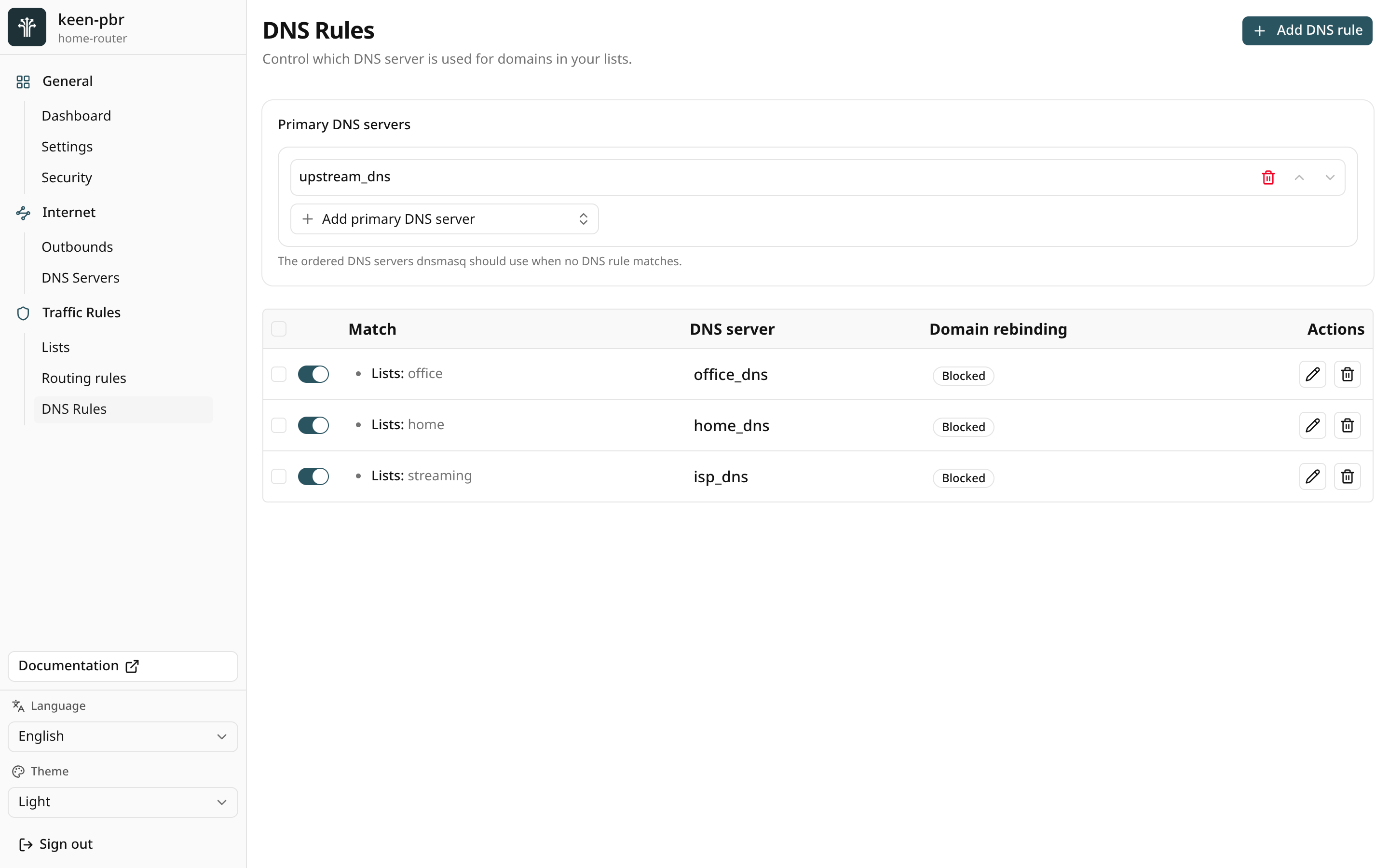
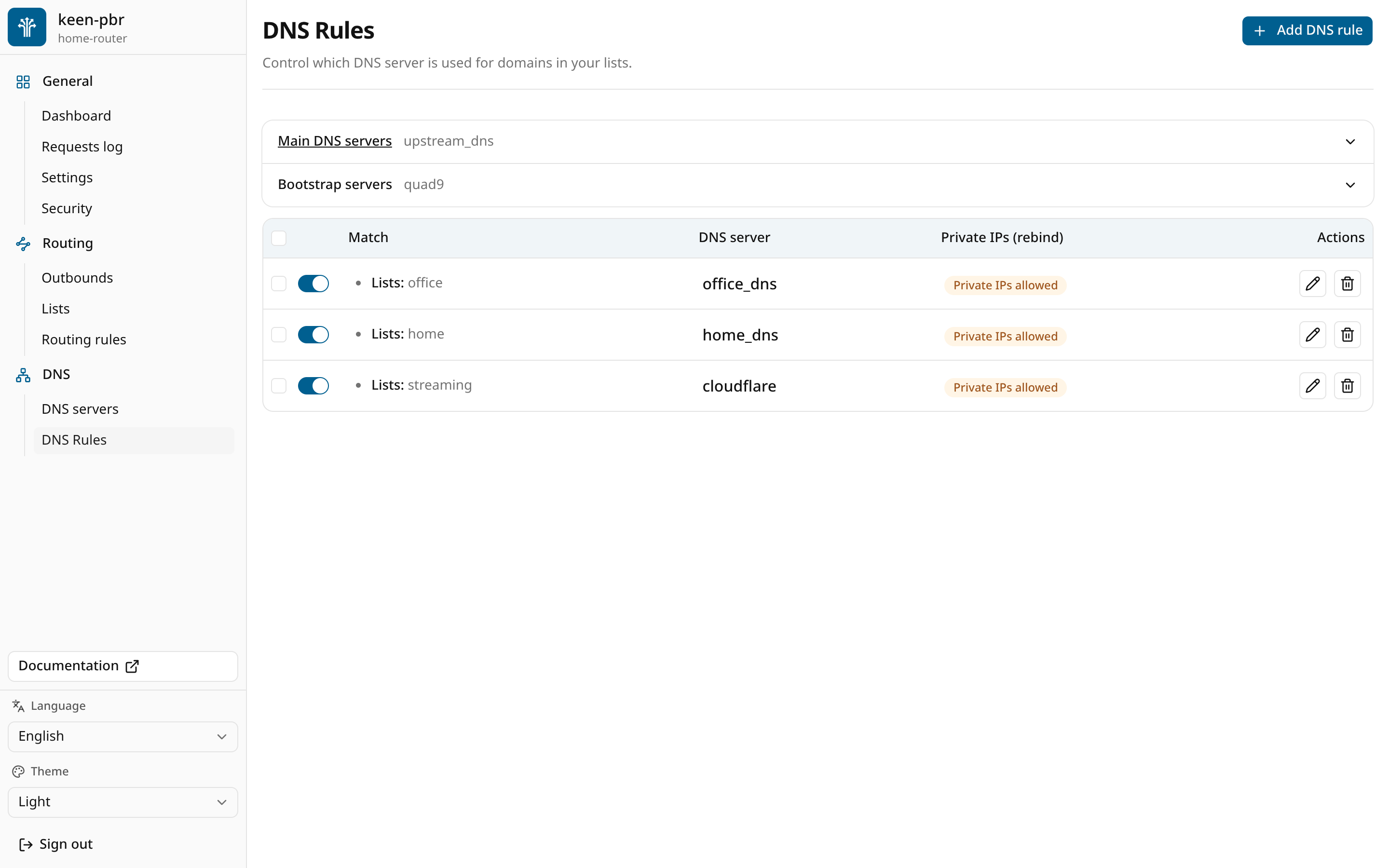 Before
After
DNS rules -
dnsmasq is needed only for split DNS.
You need it only for split DNS (different DNS servers depending on the domain) or to set DNS servers for the whole network right in keen-pbr. See Do I need dnsmasq?. keen-pbr can pick the dnsmasq instance, shows its state in the Web UI and restores it when it loses the config. New commands:keen-pbr resolver dnsmasq detectandkeen-pbr resolver dnsmasq print-config. -
Web UI on a phone.
Forms and the rule builder adapt to a narrow screen, the request log is shown as cards, and dialogs slide up from the bottom. -
Real-time updates.
Data is updated over SSE instead of HTTP polling. -
Prometheus metrics.
GET /metricsreports probe latency, link selection, list updates, balance and interception counters. It also has DNS proxy metrics: the queries to it, the answers of the servers by result, the answer time and the servers the proxy is skipping now. A Grafana dashboard (with a DNS proxy section) and alert examples are included. See REST API and DNS proxy metrics.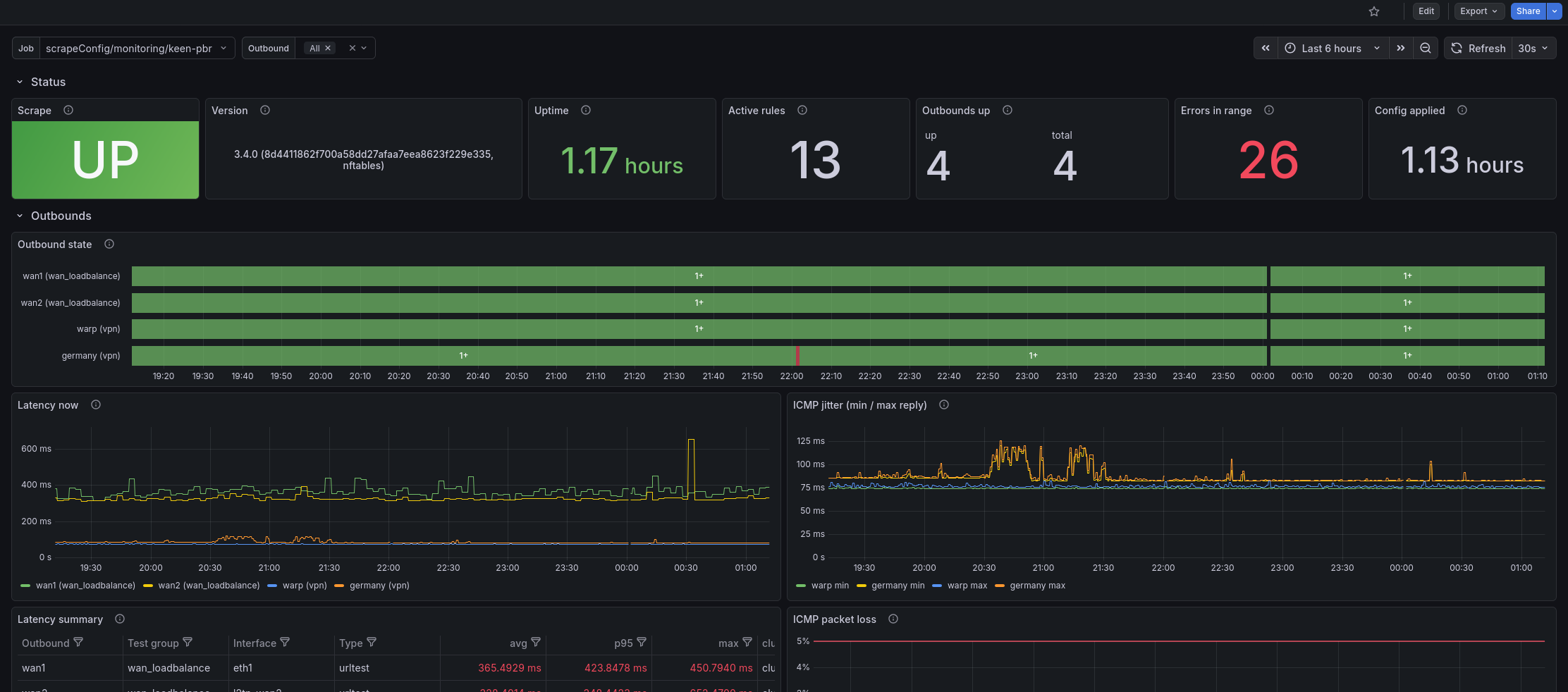
Grafana dashboard -
Removing the package also removes leftover firewall rules and dnsmasq files.
Fixes
- Fixed applying a configuration where a new list downloads through a new outbound: the apply used to fail with “Failed to prepare remote list(s)”.
urltestandicmptestgroups now accept onlyinterfaceandtablemembers: other types never worked and now fail config validation. Ablackholemember was never selected; keen-pbr now skips it and logs a warning. You do not need it to block traffic: when no link works, traffic is blocked anyway.- Fixed automatic list updates stopping after the first list change that affected routing. Lists now update on schedule.
- Fixed new devices not getting an address over DHCP when a route rule matches all UDP traffic.
- Fixed the router’s own traffic skipping route rules when
inbound_interfacesis set. - When several DNS rules name the same list, the list now uses the servers of every rule. Before, only the first rule’s server was used.
- Keenetic/NetCraze Fixed routes being built from a partially updated route table when routes change one after another during a WAN DHCP renewal.
- Fixed a list cache file being left empty after a power loss.
- Keenetic/NetCraze Fixed a package upgrade where the old version did not stop in time: it kept running after the install instead of the new one.
- Fixed the routing test with IPv6 turned off: it used to check the domain’s IPv6 addresses too.
- Fixed the routing test showing one route rule as several blocks.
- Fixed a false error in
keen-pbr statuson everyurltestandicmptestrule: the command now shows the selected link. - Fixed the Web UI losing
conntrack_on_switch,strict_enforcement_actionand theurltestprobe timeout when saving an outbound. - Fixed DNS servers with
detourthrough a tunnel: queries entered the tunnel with the ISP address and got no answer. They now use the tunnel address (for servers with an IPv4 address). - iptables
Fixed routing rules that negate several addresses (
!a,b) on iptables: such a rule used to match all traffic.
Breaking Changes
Before the upgrade. Debian
keen-pbr 3.3.x depended on dnsmasq, so apt marked it as automatically installed, and apt autoremove may remove it. If you need dnsmasq, first run:
sudo apt-mark manual dnsmasqBefore the upgrade. Keenetic/NetCraze
keen-pbr 3.3.x installed dnsmasq-full as a dependency, and opkg may remove it during the upgrade. If you need dnsmasq, first clear its “installed automatically” mark. Run over SSH:
cp /opt/lib/opkg/status /opt/lib/opkg/status.bak
sed -i '/^Package: dnsmasq-full$/,/^$/{/^Auto-Installed:/d}' /opt/lib/opkg/status
Keenetic/NetCraze
If the package is already gone and you turned on opkg dns-override, devices in your network are left without DNS: the router still hands their queries to dnsmasq, which is gone. The keen-pbr Web UI offers two ways out:
- Keep dnsmasq.
Install it again withopkg install dnsmasq-full. - Go without dnsmasq.
Turn off Manage dnsmasq configuration. Then, in the router’s web console (http://my.keenetic.net/a), runno opkg dns-overrideandsystem configuration save, and reboot the router.
After the upgrade, dnsmasq management stays on, as in 3.3.x. If you do not need it, turn off Manage dnsmasq configuration in the Web UI (General > Settings > Local DNS server management) and follow the rollback steps: Keenetic, OpenWrt, Debian. Without dnsmasq, DNS rules and main DNS servers stop working.
What to check after the upgrade:
- Kernel modules. Keenetic/NetCraze
The IP addresses of domains for filling ipset are now found by intercepting DNS replies, the HTTP Host and the SNI with NFQUEUE and NFLOG. If the Netfilter Subsystem Kernel Modules and Xtables-addons Extension Package for Netfilter components are not installed yet, install them. Then open the status page in the Web UI and run the DNS check. - iptables only. Keenetic/NetCraze
The Keenetic build always works through iptables. A config withdaemon.firewall_backend: "nftables"orstrategy: "balance"fails validation there. - Debian 11 (bullseye) is no longer supported.
- A list’s
ttl_msis now a minimum time.
It used to set how long the addresses of a list’s domains are kept. Now it is a minimum: if the TTL in the DNS reply is longer, the address is kept longer, but no more thanintercept.max_ttl_ms. Ifttl_msis not set, the minimum comes fromintercept.min_ttl_ms(5 minutes by default). - Defaults changed.
daemon.clear_dynamic_sets_on_applyis nowfalse: domain addresses are kept when a config is applied.iproute.process_router_trafficis nowfalse: route rules apply to devices in your network, not to the router’s own traffic.--log-targetisbothfor all commands. The init scripts from the package pass--log-target syslog.
- Fields that no longer work.
dns.system_resolver,dns.dns_test_serveranddaemon.resolver_ready_timeout_seconds; the log warns if they are set. Useintercept.dns.markerinstead ofdns.dns_test_server. The oldoutbounds,candidatesandweightfields inoutbound_groupsare replaced bymembers. Old configs keep working: keen-pbr rewrites them to the new format once (comments and key order are not kept). - New
versionfield.
It holds the keen-pbr version the config was written for. keen-pbr sets it when you save the config in the Web UI. If you edit the file by hand, leave it in place. - DNS check domain.
For a manual check, runnslookup check.keen-pbr.fyiinstead ofnslookup check.keen.pbr. See Troubleshooting.
If your scripts or other programs work with keen-pbr:
- The
keen-pbr resolver-config-hashcommand does nothing and always succeeds. keen-pbr generate-resolver-configacceptsdnsmasqinstead ofdnsmasq-ipsetanddnsmasq-nftset.keen-pbr statusexits with code 1 if any check failed or the problems include an error.GET /api/dns/test?show=all(andshow=full) works only when API authentication is enabled.- New API endpoints:
GET /metrics,GET /api/health/issues,GET /api/config/defaults.GET /api/status/eventsalso sends problems, routing state, authentication state and config changes.
3.3.1
25 August 2026
What’s new
- Where the log goes.
The--log-target stderr|syslog|bothoption. The service writes to syslog by default, commands in a terminal write to stderr.
Fixes
- Switching open connections.
When the selected link in aurltestoricmptestgroup stops working, keen-pbr now clears the conntrack entries of open connections, and devices reopen them through the new link, over IPv4 and IPv6. Before, connections stayed on the dead link. If the old link still works at the time of the switch, theconntrack_on_switchsetting applies. - Fixed the display of member states in
urltestandicmptestgroups (primary, backup, flaky, unavailable). - keen-pbr waits for dnsmasq to be ready for as long as
daemon.resolver_ready_timeout_secondssays, not always five seconds.
3.3.0
21 August 2026
What’s new
- Large IP lists.
You can raise the ipset size withipset_hashsizeandipset_maxelem: General > Settings > Advanced routing settings. - On
SIGUSR1keen-pbr no longer reloads the address lists.daemon.reuse_static_sets_on_runtime_refresh: falsebrings the old behavior back. - Config rollback.
If a config fails to apply, you can go back to the previous one. - The Web UI reconnects by itself when the connection to the router is lost.
- RAW separately for IPv4 and IPv6. Keenetic/NetCraze
KEEN_PBR_RAW_PREROUTINGvalues:auto,enable,disable,ipv4-onlyandipv6-only. See RAW or mangle.
Fixes
- CPU load at idle.
Fixed: keen-pbr polled state all the time and used about 20% of the CPU (measured on a mipsel router). The state is now updated on events. - Removed one cause of the
Fatal error: control socket timeout waiting for socket ackerror, which kept a large config from applying and dnsmasq from starting on slow routers.
Breaking Changes
- The
enablevalue for RAW. Keenetic/NetCraze
KEEN_PBR_RAW_PREROUTING=enablenow requires RAW support for both IPv4 and IPv6. If you need RAW for only one of them, useipv4-onlyoripv6-only.
3.2.1
15 August 2026. Version 3.2.0 was never released.
What’s new
- Password for the Web UI and API.
Password login, Basic Auth for scripts, and a list of sites the browser may let call the API (CORS). All of it is on the new Security page. See REST API. - The
icmptestoutbound.
Checks links with a ping (ICMP) instead of loading a URL. See icmptest. - You can give the router a name, and it is shown in the Web UI.
- The route check in the Web UI was redone.
keen-pbr test-routingprints plain text instead of JSON. - Unapplied config changes can be discarded in the Web UI and through the API.
- The Web UI now has links to the documentation.
- You can change the order of route rules by dragging.
- RAW or mangle. Keenetic/NetCraze
In/opt/etc/keen-pbr/defaultsyou can pick the table in which devices’ IPv4 traffic is marked. RAW is not flushed when Keenetic rebuilds its firewall and connections do not break, but it works only for devices with the Default policy. mangle suits any policy from Connection priorities, but the rules disappear while the firewall is being rebuilt. See RAW or mangle. - Packages for Debian 11 (Bullseye), 12 (Bookworm) and 13 (Trixie).
- The full package got smaller.
- The package repository moved from GitHub Pages to a separate paid host.
Fixes
- Start after a router reboot. Keenetic/NetCraze
Fixed: keen-pbr started before RCI and might fail to start. The service now waits for RCI. Details - Keenetic/NetCraze
Fixed rules with a DSCP condition: the
xt_dscpmodule is now loaded automatically. - Fixed a resource leak in the Web UI update stream.
3.1.1
26 July 2026
What’s new
- The diagnostics report you download from the Web UI now includes the last system command that failed.
Fixes
- iptables Fixed applying iptables rules, which sometimes did not work.
3.1.0
25 July 2026
What’s new
- Safe config apply.
keen-pbr first checks the new config and applies it, waits for dnsmasq to confirm, and only then saves it to disk. If something goes wrong, the file on disk stays as it was. - Apply without gaps.
nftables changes in a single transaction, and iptables and ipset are replaced without clearing them first, so traffic does not bypass the rules while a config is applied. keen-pbr removes only its own routes and rules and leaves others alone. - Strict mode.
If no link works, traffic is blocked with anunreachableorblackholeroute. - The router’s own DNS queries go through
detourtoo. - The
dscpcondition in route rules.
Route by the DSCP mark (values 1-63) that a program on a device sets. See the DSCP example. - The
conntrack_on_switchsetting.
Sets whaturltestdoes with open connections when the link changes:preserveordelete. - Strict list checks.
URL lists are downloaded only over HTTP and HTTPS, redirects included. A local list must be a regular file no larger than the set size. Incorrect domains are dropped. If the same list is downloaded several times at once, only one download runs. - The Web UI updates itself.
Changes in service, outbound and interface state show up right away, with no page refresh. Diagnostics and the DNS check cannot do this yet. - On start, stop, restart and config apply you can see which stage the service is in.
- Detailed diagnostics.
You can see whether the config in memory matches the config on disk, whether dnsmasq got the current config, and which cache files are missing. keen-pbr statustakes its data from the running service.- Marks in the RAW table. Keenetic/NetCraze
Devices’ IPv4 traffic is marked in the RAW table. Keenetic does not rebuild it, so games and calls drop less often. If RAW is not available, keen-pbr warns you and uses mangle. - Keenetic/NetCraze Next to the system interface names, the Web UI shows their names from Keenetic.
- The package now depends on
conntrack. - In the API, the
apply,start,stopandrestartcommands reply with202and an operation number. If such a command is already running, the next one gets409.
Fixes
- The route check in the Web UI is faster: up to eight addresses are checked at once.
- Fixed the whole rule being deleted when you removed one list from a rule with several conditions.
3.0.7 (beta)
29 June 2026
Fixes
- Keenetic/NetCraze Fixed the IPv6 support check in iptables mode: keen-pbr could decide that IPv6 is not supported (#139).
3.0.6 (beta)
3 June 2026. Version 3.0.5 was never released: it had a bug that kept keen-pbr from installing on OpenWrt 25.x.
Fixes
- Fixed problems that
keen-pbr statusreported while everything was fine in the Web UI. - A
urltestlink selected for both IPv4 and IPv6 is no longer treated as an error. keen-pbr statusmarks rules that pass traffic through unchanged asPASS.- With IPv6 turned off,
keen-pbr statusno longer shows IPv6 sets. - OpenWrt
Fixed the
.apkpackages and the repository index for OpenWrt 25.x. - Fixed IPv6 detection with old versions of
ip6tables-restore(#138).
3.0.4 (beta)
27 May 2026
What’s new
- The
daemon.ipv6_enabledsetting.
For networks without IPv6: withfalse, keen-pbr creates no IPv6 rules. If IPv6 is on but the system does not support it, keen-pbr says so in the log and works with IPv4 only. - Config reference check.
Before applying, keen-pbr finds references that lead nowhere: a rule pointing to a missing list or outbound, a DNS rule pointing to a missing list or server, aninterfaceoutbound without an interface, a route check without an address. - dnsmasq state is checked every 5 seconds instead of 30. When lists or DNS change, keen-pbr reloads dnsmasq and checks the result right away.
- Bulk actions.
In the Web UI tables you can select several rows and act on all of them at once. - What changes on delete.
Before deleting, you can see which rules will be removed and which DNS servers andurltestgroups will change. - Interface picker.
Shows all known interfaces, whether they are up and their addresses. You can search by address too. - Detailed route check.
Shows which rule matched, which outbound and interface were chosen, and which lists the address is in. - Before you change or delete a list, you can see where else it is used.
- Config validation errors are shown next to the fields when you save.
- Keenetic/NetCraze
On start, kernel ipset support is checked. If Netfilter components are missing, the error message is clearer. Messages about loading the
xt_multiportmodule are clearer too.
Fixes
- A URL list with inline entries no longer loses them when it is loaded from the cache.
- Fixed the Web UI on iPhone and in Safari on macOS.
- Fixed interface tracking: after a network error keen-pbr stopped noticing interface changes.
- The reload and stop commands find the service by its PID file and no longer touch other running keen-pbr processes.
- Fixed simultaneous DNS checks that interfered with each other.
3.0.3 (beta)
10 May 2026
What’s new
- The
gateway6field.
Sets the IPv6 gateway of aninterfaceoutbound. - List update errors.
Shown in the log, through the API and on the lists page. - List auto-update once a week.
This is the default in new configs, it used to be once a day. Existing configs keep their schedule. - A DNS server tag can no longer be changed when editing.
Fixes
- IPv6 leaking past the VPN.
Fixed: the missing IPv6 routes were added, and forurltestanunreachableroute was added for when no link works. - Fixed checking links over IPv6.
- Fixed keen-pbr crashing when the router has no internet.
- Fixed the handling of the
urltestcheck timeout and the priority ofunreachableroutes. - nftables Fixed port forwarding when the request comes from an address in a list.
- Fixed the display of list auto-update: the Web UI showed it as on when it was off.
- The external link icon is now clickable.
3.0.2 (beta)
26 April 2026
Breaking Changes
- New repository address. OpenWrt
Packages are now built per CPU architecture, not per router model. If keen-pbr is already installed on OpenWrt, change the repository address in the package manager settings. See Installing on OpenWrt.
Fixes
- Fixed the Apply and restart button in the bottom bar, which sometimes did nothing.
3.0.1 (beta)
25 April 2026
What’s new
- Improved the overview page.
Fixes
- The route check no longer touches the firewall. nftables
Before, the route check in the Web UI wiped firewall rules. - Fixed dnsmasq starting after a router reboot: sometimes it did not start.
- Route check through dnsmasq.
Addresses are resolved through dnsmasq, not the ISP’s DNS. Before, the check could get a reply forged by the ISP and show a wrong route. - OpenWrt Fixed nftables rules disappearing.
- fw4 support. OpenWrt
The firewall integration was redone: on newer OpenWrt versions the/etc/hotplug.d/firewall/70-keen-pbrscript stopped running. - OpenWrt
dnsmasq-fullwas added to the package dependencies. Fixed writing to the system log. - Keenetic/NetCraze
Fixed starting on old NDMS 2.x firmware with
keenetic-type DNS. - Keenetic/NetCraze DoT DNS servers from Keenetic settings are now used.
- Keenetic/NetCraze
iptablesandipsetwere added to the package dependencies. - Keenetic/NetCraze
Fixed
opkg updateerrors for those who still had the old repository address. - Fixed the Save button: after an error in the rule form it could not be clicked until the page was reloaded.
- iptables The port list is checked against iptables limits.
3.0.0 (beta)
22 April 2026
keen-pbr was rewritten from scratch. Version 2.x worked only on Keenetic and Netcraze, version 3 can also work on OpenWrt and Debian.
- Web UI and REST API.
The Web UI is easy to use from a phone too. - Link checks (
urltest).
keen-pbr checks by itself whether a link has internet and switches traffic to another one when it fails. It works with any VPN, including one installed through opkg, for example AmneziaWG-Go. Version 2.x learned a link’s state only from the Keenetic API. - New rule conditions.
Ports and source and destination addresses, exclusions with!, rules without lists. For example, you can exclude one TV from routing or send all traffic of one device to a VPN. - Inbound interface filter.
For example, rules apply in the main network and leave the guest network alone. - Gateway for the
interfaceoutbound.
You can set it explicitly. - Automatic priorities.
Routing tables, fwmark values andip rulepriorities are assigned in the order of the rules. - DNS rules separate from routing.
You can set a DNS server for domains without changing their route. - Temporarily turning rules off.
A rule can be switched off without deleting it.
How to move from 2.x: Upgrade from 2.x.
keen-pbr 2.x
Versions for Keenetic and Netcraze. The config is in TOML format, in the keen-pbr.conf file.
2.2.1
10 June 2025
- If the Keenetic API returned no data for an interface but the system sees it as up, the interface is treated as working.
- Own DNS server for ipset.
Theoverride_dnsoption in[ipset.routing]sets a separate DNS server for the domains of that ipset. - If an interface from the config is missing, keen-pbr keeps working.
keen-pbr self-checknow finds IPv6blackholeroutes correctly.
2.1.4
11 May 2025
- The
keen-pbr dnscommand shows the DNS servers from the Keenetic profile. - DoH and DoT from Keenetic.
Theuse_keenetic_dnsoption turns on DoH and DoT from the Keenetic settings, andfallback_dnssets a DNS server for when the RCI query fails. - Default policy only.
The default iptables rule serves only devices with the default policy in Connection priorities.
2.0.3
25 February 2025
- Fixed the package install and uninstall scripts.
2.0.2
17 February 2025
- Fixed the
certificate signed by unknown authorityerror that kept lists from downloading on some routers.
2.0.1
16 February 2025
- New name.
The project was renamed from keenetic-pbr to keen-pbr, and the repository address changed. How to upgrade from 1.x is in the GitHub release notes. - No files in dnsmasq.d.
keen-pbr no longer writes files to/opt/etc/dnsmasq.d/: dnsmasq gets the lists from keen-pbr at startup. Because of this dnsmasq starts more slowly: about 3.5 seconds for 43 thousand domains on a Keenetic Viva. - A separate section for lists.
Lists are set in the[[list]]section, and one list can be used in several ipsets. - New commands:
print-dnsmasq-configandupgrade-config. The second one upgrades an old config by itself when the package is upgraded. - The
dnsmasq_lists_diroption was removed.
keenetic-pbr 1.x
The first versions, under the name keenetic-pbr.
1.3.0
15 January 2025
- Fewer writes to flash.
keenetic-pbr does not overwrite files that have not changed. This spares the router’s flash memory and USB drive. - The
summarizeoption was removed: because of a bug it removed needed addresses from the list.
1.2.0
8 January 2025
- New commands:
interfaces(list of interfaces),self-check(checks routes and rules) andundo-routing(removes everything keenetic-pbr set up). - The
fileoption adds a list from a local file. - Kill switch.
Thekill_switchoption blocks the addresses from the lists when the VPN is down. - Several interfaces.
Theinterfaceoption was replaced byinterfaces: you can list several interfaces, and the first one that is up is used. - The
use_keenetic_apioption (on by default) checks through RCI whether an interface has a connection. applyre-reads the lists and sets up the routes every time. You no longer need to restart OPKG or the interfaces.
1.0.1
17 November 2024
- ipset is created even if the lists have no IP addresses.
- Experimental IPv6 support.
1.0.0
11-16 November 2024
- First release. Follow-up builds fixed the
downloadcommand messages for local lists, the default dnsmasq config, and the installer, which no longer replaces an existingdnsmasq.conf.